Major Arcana
Wheel of Fortune
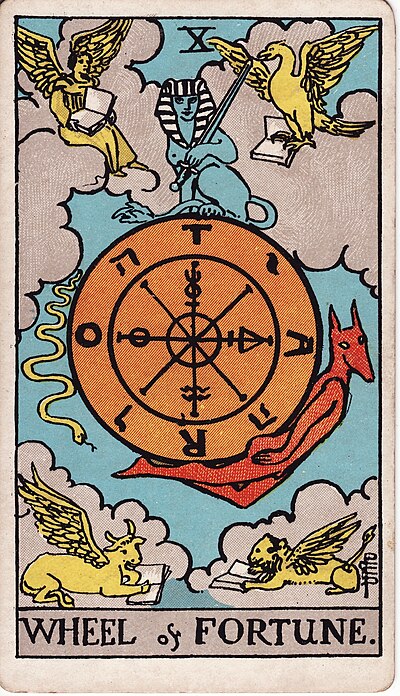
The Wheel of Fortune is a great disk turning in the clouds, creatures rising on one side and falling on the other, a sphinx sitting still on top. The card is about cycles — the turning point that arrives whether or not it was planned — and about the difference between what the wheel does and what you do while it turns.
- Upright
- cycles · destiny · turning point
- Reversed
- bad luck · resisting change · setbacks
- In numerology
- Number 1
What the card shows
The Wheel of Fortune hangs in the sky, its rim inscribed with letters that spell TARO, or ROTA, or TORA, depending on where you begin, and between them the four Hebrew letters of an old name for God. On its spokes are the alchemical signs for mercury, sulfur, water and salt. A sphinx with a sword sits calm on top; a serpent slides down the left side; a jackal-headed figure climbs the right. In the four corners, on clouds, a winged lion, bull, eagle and human figure each read a book. Nobody in the picture is turning the wheel. It turns. The number is ten: one and zero, a cycle closing and the next one beginning at the same moment.
Wheel of Fortune · Upright meaning
Upright, the Wheel of Fortune names a turning point — a change of season in a life, a stroke of what people call luck, the moment a long pattern finally shows itself to be a pattern. The gift of the card is a wider view: what feels like a random rise or fall is part of a movement that has a shape, and the shape can be learned. It asks you to notice the cycle you are in and where on the rim you are standing, because the same wheel that lifts also lowers, and neither is personal. The tradition calls this destiny; the card is quieter than that word. Its shadow sits close: a belief that everything is the wheel's doing leaves nothing for you to do, and a belief that nothing is leaves you fighting the weather. The card is not telling you what turns next. It is asking what you have seen come around before, and what you did the last time.
In love
In love the Wheel is the meeting that happened because of a canceled train, the relationship that changes phase without anyone deciding, the return of a feeling you thought had finished. It favors the willingness to let a connection have seasons — closeness and distance, ease and effort — without reading every dip as an ending. Where a relationship is older, the card asks which of its cycles you have both lived through already, and whether you recognize this one. The reflection it offers: what in this connection is genuinely new, and where is the wheel coming around to a place you have been?
In work and money
At work the Wheel is the reorganization, the market turning, the opportunity that arrives sideways from a direction nobody was watching. It is a card of timing rather than effort, and it is honest about that: some of what happens this quarter is not about how hard anyone worked. It rewards the person who has learned the rhythm of their field — when things are bought, when they are cut, when nothing moves — and who keeps something ready for the turn. Its question for the working week: which part of what is happening around you is the wheel, and which part is still yours to steer?
What the card asks
Read the rim. Find where you are in the cycle and act for the position you are in, not the one you wish you had. Keep the sphinx's posture — still at the center while the edge moves — and hold the good turn lightly, since it is a turn. And when a change arrives that you did not choose, ask what it is making room for before you decide it is against you.
Wheel of Fortune · Reversed meaning
Reversed, the Wheel of Fortune seems to stick, or to turn the wrong way. Setbacks arrive in a run; what looked like bad luck begins to feel like a verdict. Or the card shows the other failure — resisting the turn, gripping a season that has ended, standing on the rim with your heels dug in while the wheel moves anyway and calling the friction fate. Both are the same card unbalanced: a cycle misread as a sentence, or a change refused until it becomes a fall. The gift is still there, underneath, in the fact that a wheel by definition does not stay where it is. The reflection is not «wait for better luck», but «what are you refusing to let turn?»
In love
Reversed in love, the Wheel of Fortune can describe a relationship stuck in a loop — the same argument on a monthly schedule, the same distance closing and opening — or a run of bad timing that has started to feel like a curse on the whole subject. It may point to a fear of change so strong that a good connection is being held still until it stops breathing. The question it leaves: is this a hard season, or the same season for the third time?
In work and money
In work the reversed Wheel of Fortune is the plan built on last year's turn, the person still waiting for a market that has moved, the repeated setback that nobody has yet called a pattern. It can be the refusal to notice that a role, a career stage, a product or a strategy has completed its cycle. The card asks for one honest look at the calendar — what has happened at this point in the year before, and what came after — and for a decision about what you are holding onto because it worked once.
What the card asks
Loosen your grip on the rim. If the run has been bad, look for the part of the wheel you can actually reach: the small choice inside the large circumstance. If you have been resisting, name what has ended, out loud, and see how much lighter the next turn feels. The Wheel of Fortune reversed is not a warning of misfortune. It is a reminder that a cycle you refuse to see is still a cycle, and that the only fixed point on the wheel is the one who keeps watching it.
Updated September 23, 2026