Minor Arcana · Wands
Ten of Wands
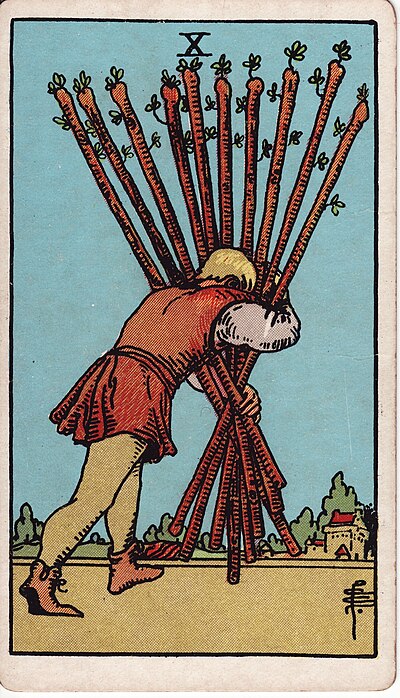
The Ten of Wands is a man bent almost double under ten staves gathered in his arms, walking toward a town he cannot see because the load is in the way. The card is about burden — the responsibility taken up willingly and carried past the point where it should have been shared — and about the difference between commitment and load-bearing.
- Upright
- burden · responsibility
- Reversed
- release · delegation
- In numerology
- Number 1
What the card shows
The man in the Ten of Wands walks away from us across a flat field, bent forward under ten wooden staves that he holds bundled in his arms and pressed against his chest and face. The staves fan out above his head and block his view; he is looking at the ground because there is nowhere else to look. His tunic is orange; his steps are heavy. In the distance, not far, stands a town — a house, trees, a low horizon — that he is presumably heading for and cannot see. The sky is clear; the day is ordinary. Nothing is chasing him. Every one of the ten wands has its leaves. Ten ends the suit, the whole of it gathered up at once, and the card shows what it feels like to carry all of it alone.
Ten of Wands · Upright meaning
Upright, the Ten of Wands names a load that has become the whole of the walk. Responsibility has been taken up — for a family, a team, a project, everyone's problems at once — and the card's gift is that this is a card about strength: the man is carrying it, all ten, and the town is near. It honors the person who says yes, who picks up what others drop, who finishes what they started even when the starting was somebody else's idea. It asks you to see the burden clearly, including its dignity. The shadow sits close, closer than on any other card in the suit. The staves are held so that they block the view, and the man has arranged them that way himself; they could be carried on the shoulder, or in two trips, or by two people. A responsibility that was chosen can become a responsibility that is used — to avoid choosing anything else, to be too busy to be asked, to earn a rest that never comes because the load is never set down. The card is not telling you to drop everything. It is asking which of the ten you actually agreed to carry, which you picked up because nobody else moved, and what you would see if you lifted your head.
In love
In love the Ten of Wands is the partner who carries the household, the emotional labor done by one person for two, the relationship kept going by effort that has stopped being noticed because it never stops. It is a card of devotion, and it is honest that devotion can be a way of never being the one who needs. Where a connection is new, the card asks whether you have already begun carrying the other person's weight before they asked you to, and why. Where it is older, it asks what you have been holding for so long that the other person no longer knows it is heavy. The reflection it offers: if you set down one of the ten things you carry for this relationship, which would it be — and have you ever said its name out loud to the person beside you?
In work and money
At work the Ten of Wands is the person who does three jobs and is thanked for one, the manager who has absorbed every task their team dropped, the career built by the one who could not say no. It is a card of overwork dressed as commitment, and it is honest that the disguise is convincing from the inside. It rewards the person who can distinguish the responsibility they hold from the pile they have been handed, and who can put a number on the difference. Its question for the working week: how many of the things you carry at work are actually yours — and who would pick up the others if you set them down where they could be seen?
What the card asks
Stop, and shift the load onto your shoulder so you can see. Count the staves. Name the ones you chose, the ones you were given, and the ones you simply found in your arms. Carry the first kind to the town; it is close. Set the second kind down where the person who gave them can see, and say what you are doing. Leave the third kind in the field. Nobody in the picture is making you carry all ten. The card is asking who you think is.
Ten of Wands · Reversed meaning
Reversed, the bundle loosens and staves fall. The Ten of Wands reversed is about release — the burden set down, the responsibility handed back or shared, the discovery that the town was reachable in half the time with half the load — and it describes delegation in its honest form: not dumping, but asking, and letting someone else be capable. It can also describe the other kind of dropping: the collapse of someone who carried too long and can now carry nothing, everything let go at once and left in the field for others to trip over. Both are the same card unburdened, and only one of them was a choice. The gift is still there, underneath — the strength that carried ten can carry three easily, and the head is up. The reflection is not «let it go», said lightly, but «which of these did you put down, which fell, and who is going to pick up the ones you dropped?»
In love
Reversed in love, the Ten of Wands can describe the moment one partner finally says «I cannot hold all of this» and the other, to everyone's surprise, takes some. It may point to a relationship rebalanced after years of one person carrying, or to the collapse of the carrier — the sudden refusal that looks like coldness and is really depletion. The question it leaves: if you handed this person half of what you carry for the two of you, would they take it — and have you ever given them the chance to?
In work and money
In work the reversed Ten of Wands is the handover done properly, the task delegated to someone who turns out to be good at it, the manager who stops absorbing and starts assigning. It can also be the abrupt departure of the person everyone relied on, and the pile of staves left in the field that nobody knew was one person's whole job. The card asks for one honest look at what you have released at work — whether it was passed to someone or simply dropped — and at what you are still carrying that you have told no one about.
What the card asks
Hand one staff to someone, on purpose, with words. Not the least important one; a real one, with the trust that it costs. If you have already dropped everything, gather only what is yours and let the rest be found by its owners. If you are still carrying all ten and telling yourself release is for other people, notice that the man in the picture cannot see the town, and the town is right there. The Ten of Wands reversed is not a failure to cope. It is a reminder that strength includes the strength to be helped.
Updated September 23, 2026