Minor Arcana · Swords
Ten of Swords
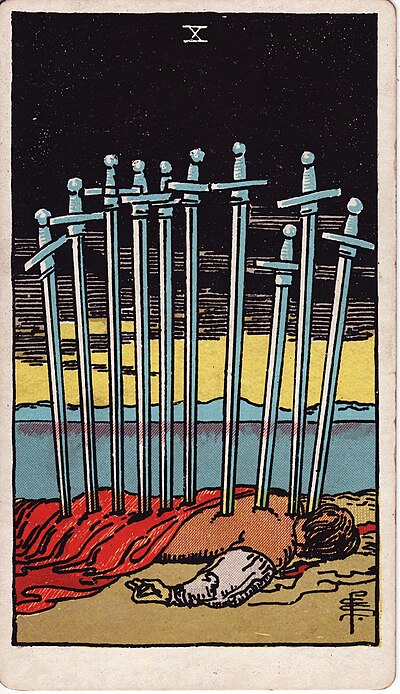
The Ten of Swords is a man lying face down on the ground with ten swords along his back, under a black sky that is turning gold at the horizon. The card is about an ending that is complete — the worst of it already happened — and about the difference between rock bottom and a floor. It is not a card about anyone being harmed.
- Upright
- painful ending · rock bottom
- Reversed
- recovery · rebirth
- In numerology
- Number 1
What the card shows
In the Ten of Swords a man lies face down on bare ground near the edge of water, and ten swords stand upright in his back, driven in from the neck downward. A red cloth is draped over his lower body. His face is turned to the side; one hand lies open on the ground, two fingers extended in the same gesture the Hierophant makes in blessing. Above him the sky is black, a solid dark that takes up most of the picture — but along the horizon it has turned gold, and beyond the still water low mountains stand in the first light. Nobody else is in the picture. Nothing is moving. It is one of the deck's most theatrical images, and it is theatrical on purpose: ten swords is not a number of wounds anyone needs; it is the number of a thing that is completely, unarguably over. Ten is the last of the suit, and the card shows what the mind's story looks like when it has run out.
Ten of Swords · Upright meaning
Upright, the Ten of Swords names an ending that has finished ending. Something is over — a relationship, a job, a version of the self, a hope held past its life — and it is over in a way that leaves no room for appeal. The card's gift, which is real and arrives late, is exactly that finality: no more waiting for the blow, no more bracing, no more wondering whether it can be saved. The card reads this as certainty, not as a verdict — and there is solid ground in that certainty. It is a card of the painful ending and of the bottom being reached, and it asks for one thing only — to stop struggling against a thing that has already happened — and it rewards the person who can lie still long enough to notice the horizon. The card is honest that this is a card about a story, not a body: nobody needs ten swords, and the tenth sword is the mind's own exaggeration, the drama of «everything is ruined» that the picture shows so that it can be seen for what it is. The shadow sits close to the gift. A bottom can be made into a residence; the ending can be told and retold until it is the only story, and a person can lie under swords they could have stood up from years ago. The card is not telling you that an ending is on its way. It is asking what has already ended that you are still fighting, whether you have let it be as over as it is, and whether you have seen the color of the sky.
In love
In love the Ten of Swords is the ending nobody can argue with — the relationship finished so completely that even the hope is gone, the betrayal that leaves nothing to salvage, the breakup that is a relief in the same hour that it is a grief. It is honest that a total ending is sometimes the kindest, because it leaves no half-open door to stand in. Where a connection has ended, the question is whether you are still lying on the ground out of grief or out of habit. Where a relationship has survived something this size, it asks whether what survived is the old relationship or a new one that has not yet been named. The reflection it offers: what in this love is genuinely over — and what have you been keeping alive by lying next to it?
In work and money
At work the Ten of Swords is the company that closes, the project killed beyond resurrection, the career path that ended with a sentence in a meeting. It is a card of professional finality, and it is honest that some endings at work feel exactly like this — total, public, and undeserved — and that the sky still does what it does the next morning. It rewards the person who can say «that is over» without drawing a conclusion about your whole life, and who notices the gold at the horizon while still lying on the ground. Its question for the working week: what at work has definitively ended that you are still treating as a fight — and what would be possible if you stopped?
What the card asks
Lie still for one more minute. Let what has ended stay ended — without appeals and without trying to bring it back. Count the swords if you must, and notice that ten is more than the thing needed; some of them are the story you are telling about it. Then turn your head toward the water. The sky at the horizon is a color you have not looked at yet. You do not have to stand up today. You only have to see that the light is coming from a direction.
Ten of Swords · Reversed meaning
Reversed, the swords fall out and the man moves. The Ten of Swords reversed is about recovery — the getting up that follows the lying down, the first day the ending is a fact and not a wound, the strength that appears only after everything that was not strength has been taken away. And it is about rebirth in the plain sense: a person who has been to the bottom and is now walking, lighter for having nothing left to carry. It can also show an ending refused, the swords pulled out one by one and kept, the story of the disaster told so often it has become a career, or the fear of a bottom that never actually arrived and has been braced for since. All of these are the same card at dawn. The gift is still there, underneath — the ground that was rock bottom is also the first solid thing in a long time. The reflection is not «you survived», said lightly, but «what did the bottom teach you that the fall could not — and what are you going to build on it?»
In love
Reversed in love, the Ten of Swords can describe the person who has finally stood up from an ending and found their legs work, or the relationship that came back from something that should have been fatal and is different now in every way. It may also point to a wound that is kept open by retelling, or to a fear of the total ending that keeps someone from ever fully entering a love. The question it leaves: are you recovering from this — or have you made the ending into the most important thing about you?
In work and money
In work the reversed Ten of Swords is the professional who was laid off and, a year later, cannot imagine having stayed; the team that lost everything in one quarter and rebuilt something smaller and truer; the failure that has become the founding story rather than the ending. It can also be the person who survived a professional disaster and now expects one every Monday. The card asks what you have already recovered from at work — and whether you have let yourself stand up, or are still lying down out of caution.
What the card asks
Stand up. Leave the swords in the ground; they are not yours to carry. If you have recovered, walk toward the light without narrating the fall every step of the way — the story is true and it is not the whole of you. If you are still bracing for a bottom you have never actually hit, notice how long you have been lying down for a blow that did not come. The Ten of Swords reversed is not a lucky escape. It is a reminder that the floor of a thing is also the ground of the next one, and that the horizon was gold the whole time.
Updated September 30, 2026