Minor Arcana · Swords
Page of Swords
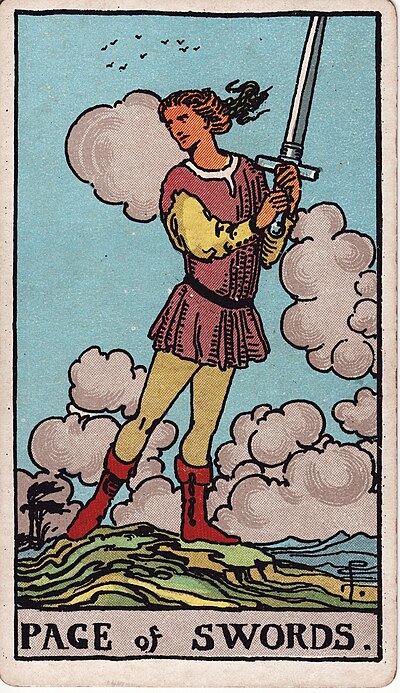
The Page of Swords is a young figure on a rise of ground, sword raised in both hands, hair and clouds blown by the wind, with birds crossing the sky. The card is about curiosity — the mind that has just learned to ask and cannot stop — and about the difference between vigilance and suspicion.
- Upright
- curiosity · vigilance
- Reversed
- gossip · scattered thoughts
What the card shows
The Page of Swords is a young person on uneven high ground, feet apart, holding a sword upright in both hands and looking back over one shoulder as if they have just heard something. Their hair blows sideways; the trees behind them lean in the same wind; the clouds billow across a pale sky. In the distance a flock of birds crosses high up, and on the horizon rises a low blue mountain. The tunic is violet, the boots are high, and the posture is alert, quick, a little theatrical — a person who has picked up a real blade for the first time and is not entirely sure it is not going to move on its own. Nothing is attacking. The Page is the first court card of the suit: thought as a messenger, someone young in the element of air who has just discovered what a question can do.
Page of Swords · Upright meaning
Upright, the Page of Swords names a mind that has woken up. Something has become interesting — a subject, a person, a problem — and the card's gift is curiosity in its most energetic form: the question asked, the fact checked, the idea turned over and looked at from the other side. It is a card of mental alertness, of vigilance in the good sense — noticing, watching, staying awake to what is actually happening — and it asks for the Page's posture: sword up, eyes open, ready to learn something today that was not known yesterday. It rewards the person who asks the question everyone else was too polite or too tired to ask. The shadow sits close to the gift, and in this suit it has an edge. A mind that asks everything can trust nothing; vigilance shades into suspicion, curiosity into intrusion, and the sword raised in both hands is raised at no one in particular, which is how a Page cuts things by accident. The card is not telling you that something is wrong. It is asking what has caught your attention lately, whether you are investigating it or only watching it nervously, and what you would do with the answer if you found it.
In love
In love the Page of Swords is the interest that asks questions — the person who wants to know how you think, the conversation that goes until three because neither of you has run out of things to ask, the early stage when everything about the other is data. It favors honesty and mental connection, and it is honest that a Page's curiosity can tip into interrogation. Where a connection is new, the card asks whether you are learning this person or investigating them, and whether they can tell which. Where it is older, it asks when you last asked your partner a question you did not already know the answer to. The reflection it offers: what do you still not know about this person that you are genuinely curious about — and when did you last ask?
In work and money
At work the Page of Swords is the new analyst who finds the error everyone missed, the question in the meeting that reopens the settled plan, the habit of checking the source rather than the summary. It is a card of intellectual alertness, and it is honest that alertness is exhausting to be around when it never rests. It rewards the person who asks «how do we know that?» once per meeting rather than ten times, and the manager who gives a curious junior something real to investigate. Its question for the working week: what at work have you accepted without checking — and what is the one question that would test it?
What the card asks
Raise the sword, but hold it steady. Ask the question you are burning to ask — one, well aimed, in plain words. Then listen to the whole answer before you raise the next one. Watch the birds, not the shadows: there is a difference between noticing and being on guard, and the wind is not a threat. Curiosity is a blade for opening things, not for keeping them at a distance.
Page of Swords · Reversed meaning
Reversed, the wind turns and the sword swings wide. The Page of Swords reversed describes scattered thoughts — the mind that asks everything and finishes nothing, the attention pulled in nine directions by the next interesting thing, the research that never becomes a conclusion. Then there is gossip: curiosity turned outward onto other people's business, the question asked about someone rather than to them, the sword used to cut small pieces off reputations. It can also show a vigilance that has become suspicion of everyone, or a Page who has been told so often to stop asking that they have stopped thinking. All of these are the same card with the blade out of control. The gift is still there, underneath — the mind that scatters is a mind that is fast, and speed can be pointed. The reflection is not «focus», but «which of the things you are watching actually deserves the sword — and which are you watching to avoid it?»
In love
Reversed in love, the Page of Swords can describe someone unable to stop checking — the messages read, the questions that are really tests, the curiosity that has become surveillance. It may point to a relationship talked about with everyone except the person in it, or to a mind so scattered that the partner can never quite get an answer. The question it leaves: are you asking this person what you want to know — or asking everyone else, and watching?
In work and money
In work the reversed Page of Swords is the team that gossips instead of asking, the early-career analyst with forty open tabs and no recommendation, the meeting in which every question is a way of not deciding. It can be a workplace where curiosity has become suspicion and everyone is watching everyone. The card asks for one honest look at where your attention at work is actually going — and at whether the questions you are asking are about the work or about the people.
What the card asks
Lower the sword and pick one thing to look at. If your thoughts are scattered, write down every question on your mind and choose the one that would change something; the rest can wait. If you have been talking about someone, go and talk to them instead — the same curiosity, aimed properly. If you have been watching everyone, watch the birds for a while. The Page of Swords reversed is not a mind that is broken. It is a reminder that a sharp mind needs one target, and that the wind is not an excuse for cutting whatever is nearest.
Updated September 23, 2026