Minor Arcana · Swords
Knight of Swords
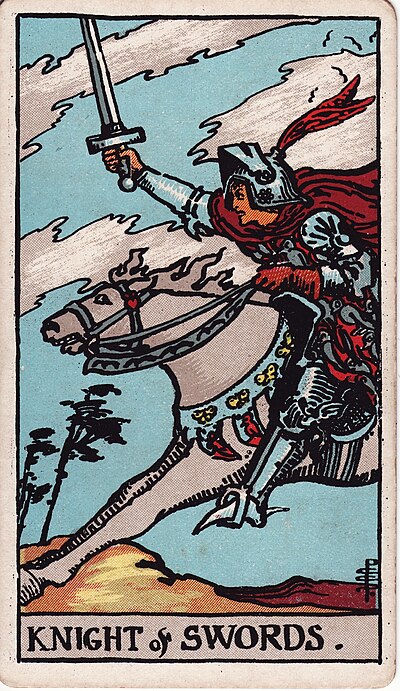
The Knight of Swords charges at full gallop on a white horse, sword raised, into a wind that bends the trees and tears the clouds. The card is about decisive action — the thought that has become a charge — and about the difference between ambition and a stampede.
- Upright
- ambition · decisive charge
- Reversed
- recklessness · scattered force
What the card shows
The Knight of Swords, in full armor, charges across the picture on a white horse at a gallop, leaning forward, sword raised high in one hand. His visor is up; his face is set. The horse's harness is decorated with butterflies and birds, and its mane and the knight's red plume stream back with the speed. Behind them the sky is full of wind-torn clouds, and the few trees on the horizon bend hard in the wind. The ground is bare. There is no enemy in the picture — only the rider, the speed, and the weather he seems to be making. The Knight is thought in motion: the element of air in a person who has made up his mind and is already at full gallop.
Knight of Swords · Upright meaning
Upright, the Knight of Swords names an idea that has become an act. The waiting is over; the argument has been won inside the head; and the card's gift is decisiveness — the charge made while the wind is behind you, the ambition that does not apologize for itself, the courage to go fast when fast is what the situation needs. It is a card of intellectual force and of action taken on conviction, and it asks for the Knight's kind of nerve: to commit fully, to stop deliberating once the deliberation is done, to cut through what others are still discussing. It rewards the person who moves when the window is open and does not mistake speed for recklessness when the ground has actually been checked. The shadow sits close to the gift, and it rides at the same speed. A charge with no enemy in front of it is a stampede; the Knight can be so certain that he does not see who is on the ground, so fast that he arrives before he has decided where. The horse is white and the wind is up, and both of those are dangerous to a person who enjoys them too much. The card is not telling you to draw the sword. It is asking what you have decided, whether the deciding is actually finished or only impatient, and what is standing where you are about to ride.
In love
In love the Knight of Swords is the declaration made without a net — the truth said fast, the proposal that could not wait another week, the person who arrives with their mind made up and says so. It favors directness over hinting, and it is honest that a mind this decisive can leave the other person's feelings behind on the road. Where a connection is new, the card asks whether you are moving at your speed or at theirs, and whether you have asked. Where it is older, it asks when you last said the hard thing straight instead of managing it, and what happened. The reflection it offers: what have you decided about this relationship that you have not yet said — and are you sure the deciding is done?
In work and money
At work the Knight of Swords is the decision made in the meeting instead of after it, the project driven through resistance by one person's clarity, the founder who sees the market and moves before the report is finished. It is a card of ambition acted on, and it is honest that ambition at this speed is right often enough to be dangerous. It rewards the person who commits and communicates, and the leader who can channel a charge into a direction the team can follow. Its question for the working week: what at work have you been deliberating that is actually decided — and what would happen if you simply rode?
What the card asks
Ride, and know where. Say the decision aloud before you act on it, so that the speed has a destination. Keep the visor up: the point of charging is to see the field, not to feel the wind. Look once for who is on the ground in front of you. Then go, all the way, without looking back to check whether the committee approves. A charge half-made is the worst of both.
Knight of Swords · Reversed meaning
Reversed, the horse runs away with the rider. The Knight of Swords reversed describes recklessness — action taken only to end the strain of not acting, the charge into a field nobody checked, the truth said so fast and so hard that it did damage the truth did not require. Its twin is scattered force: energy spent in every direction, the argument won and the war lost, the Knight who has charged so many things that nothing is left standing including him. It can also show the opposite: a rider who has reined in so hard that the decisiveness has turned to frustration, all the certainty and none of the motion. All of these are the same card without a line to ride. The gift is still there, underneath — the force that scatters is force, and force can be aimed again. The reflection is not «slow down», but «what were you riding toward before the riding became the point — and is it still there?»
In love
Reversed in love, the Knight of Swords can describe the argument that went from disagreement to damage in a single sentence, the decision announced instead of discussed, the person who leaves so fast that nobody is sure what happened. It may point to a partner whose certainty has become a weapon, or to one who has been overridden so often they have stopped speaking. The question it leaves: when you were last this sure about something between you, who was on the ground when you finished?
In work and money
In work the reversed Knight of Swords is the reorganization done in a week and regretted for a year, the leader whose decisiveness has become a series of reversals, the brilliant colleague whose career burns through three teams because nobody can keep up or bear to. It can be the strategy charged at without a look at the field. The card asks for one honest look at whether your speed at work is serving a decision or replacing one — and at what your charges have cost the people who had to follow them.
What the card asks
Rein in, but do not stop. If you have been reckless, name what you were actually trying to reach and check whether the charge got you closer or only further from where you started. If your force is scattered, choose one thing to be decisive about this week and be decisive about nothing else. If you have been frozen with your sword in the air, put it down for a day and pick it up pointing somewhere. The Knight of Swords reversed is not a defeat. It is a reminder that a charge without a direction is just weather, and that you are the rider, not the wind.
Updated September 23, 2026