Minor Arcana · Swords
Nine of Swords
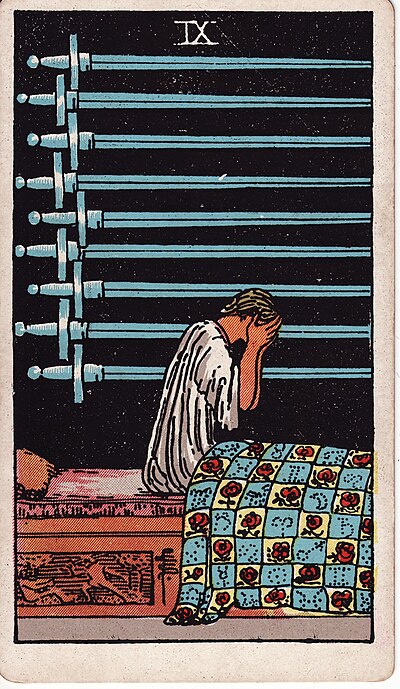
The Nine of Swords is a figure sitting up in bed in the dark, face in their hands, nine swords hanging flat on the black wall behind them. The card is about the worry that comes at night — the mind with no one to argue with but itself — and about the difference between a fear and a fact.
- Upright
- anxiety · sleepless worry
- Reversed
- hope returning · seeking help
- In numerology
- Number 9
What the card shows
The Nine of Swords is a night scene: a figure sits upright in a bed, the covers pushed down, their face buried in both hands. Behind them the wall is black, and on it hang nine swords, one above the other, horizontal, points all to one side, like a shelf of blades. The quilt over the bed is patterned with squares — roses alternating with the signs of the zodiac — and along the wooden side of the bed a carving shows one small figure defeating another. There is no window and no light except what falls on the sleeper's white gown. Nothing in the room is moving toward them; the swords are on the wall, not in the bed. Nine stands one step short of the end, and the card shows what the night before an ending feels like from inside it: everything imagined, nothing yet happened.
Nine of Swords · Upright meaning
Upright, the Nine of Swords names the worry that arrives when there is nothing to do about it. It is the middle of the night, the mind is awake and alone. The card's gift — which is real, though it does not feel like one — is honesty about the shape of this: the swords are on the wall, hung in a row, every one of them a thought and none of them touching the bed. Anxiety is the card's subject, and the card does not pretend it away. It asks you to notice that the fears are being counted in the dark, where they are largest, and it rewards the person who can tell themselves «this is three in the morning, and three in the morning lies». It is also honest that the sleeplessness is telling you something: a worry this loud usually has a real thing underneath it, smaller than the noise. The shadow sits close to the gift, and on this card it is the whole room. The mind that can imagine nine disasters can imagine them every night; worry becomes a habit that feels like vigilance, and the sleeper begins to believe the swords are the room. The card is not telling you that your fears are groundless. It is asking which of the nine swords is actually yours, what it looks like in daylight, and who you could tell about it.
In love
In love the Nine of Swords is the night spent rehearsing the conversation, the message reread until it means everything, the fear that the relationship is ending built entirely out of silence and the hour. It is honest that a heart can lie awake over something real and over nothing, and that from inside the bed the two feel identical. Where a connection is new, the card asks how much of your worry about this person is about them, and how much is the old swords you brought to the room. Where it is older, it asks what you have been lying awake over that you have not said aloud to the person sleeping beside you. The reflection it offers: which of your fears about this love would survive being said out loud, in daylight, to the person it is about?
In work and money
At work the Nine of Swords is the email composed at two in the morning and never sent, the presentation rehearsed until it is a nightmare, the fear of the review that is worse than any review. It is a card of anxiety about work rather than work itself, and it is honest that the anxiety costs more hours than the task would. It rewards the person who can write the worry down and look at it as a list rather than a wall, and the manager who knows that a silent team is often a frightened one. Its question for the working week: what are you losing sleep over at work — and what is the smallest daylight action that would tell you whether the fear is a fact?
What the card asks
Take your hands off your face. Look at the wall: nine swords, all hanging, none moving. Name each one out loud, and notice which names sound foolish once they are spoken — those can go back to sleep. The one that does not sound foolish is the real one; write it down and leave it on the table for the morning, where it belongs. Then lie back down. Nothing in the room is going to be decided tonight, and the quilt has roses on it.
Nine of Swords · Reversed meaning
Reversed, the light comes in and the sleeper looks up. The Nine of Swords reversed describes hope returning — the morning after the worst night, the discovery that the disaster imagined nine ways arrived in none of them, the mind that can think again because it has stopped counting. Its other movement is seeking help in the plainest sense: the fear said aloud to someone, the lamp turned on, the question asked of a person who can actually answer it instead of the dark. It can also show the opposite: a worry that has gone so deep it no longer keeps the person awake because they have stopped expecting anything, or a relief that is only the exhaustion of a fear too tired to continue. All of these are the same card with the night ending. The gift is still there, underneath — a mind that can imagine nine disasters can, in daylight, imagine nine ways through. The reflection is not «see, it was nothing», but «what changed when you said it out loud — and why did you wait until morning?»
In love
Reversed in love, the Nine of Swords can describe the relief of the conversation finally had at breakfast, the fear that dissolved when it was spoken, the partner who turns out to have been lying awake over the same thing on the other side of the bed. It may point to a worry released, or to one so worn in that it has become the texture of the relationship and no longer even wakes anyone. The question it leaves: what fear about this person would you be able to let go of if you heard their answer — and what is stopping you from asking?
In work and money
In work the reversed Nine of Swords is the review that turns out to be ordinary, the fear told to a colleague who says «me too», the problem that shrinks to its actual size the moment it is written down and shown to someone. It can be the manager who finally asks a quiet team what it is afraid of. It can also be the career burnout that has stopped worrying because it has stopped caring. The card asks what you have been carrying alone at work — and who could hear it without the world ending.
What the card asks
Turn on the light and tell someone. If hope has returned, do not wait to feel certain before you act on it; act small and let the certainty follow. If you are still in the dark, choose one person — not the most impressive, the kindest — and say the fear in one sentence. If the worry has gone quiet because you have stopped expecting anything, that is not peace, and it deserves a witness too. The Nine of Swords reversed is not the end of fear. It is a reminder that a sword on the wall is a thought, that thoughts shrink when they are spoken, and that the bed was never the whole room.
Updated September 23, 2026