Minor Arcana · Swords
Eight of Swords
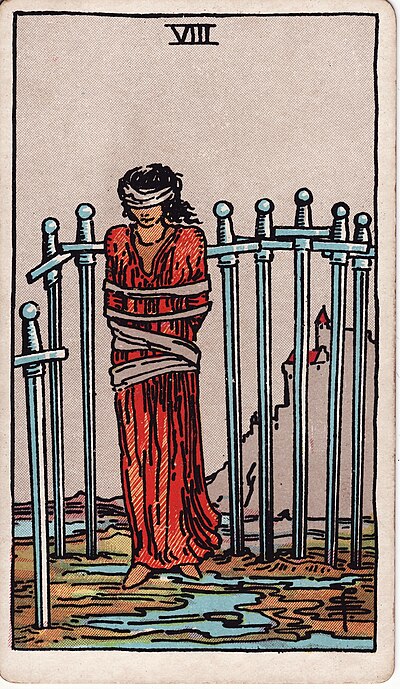
The Eight of Swords is a blindfolded, loosely bound woman among eight swords planted in wet ground below a castle, with room between them to walk. The card is about restriction — the limits that are real and the ones that are only unchecked — and about the difference between a cage and a belief in one.
- Upright
- restriction · self-imposed limits
- Reversed
- liberation · new options
- In numerology
- Number 8
What the card shows
In the Eight of Swords a woman in a long red dress stands with a white blindfold over her eyes and her arms bound loosely to her sides by a cloth wound around her. Around her, eight swords stand upright in the ground, planted in a rough half-circle — behind her and to the sides, none directly in front. The ground is wet, pools of water at her feet; behind her, on a cliff, stands a castle. The sky is a flat gray. She does not move. The swords are close but not touching her, and the bindings are the kind that could be worked loose by anyone who tried. The picture leaves the way ahead open and shows a person who cannot see that it is. Eight is the number of structure, and here the structure is a fence with a gap in it.
Eight of Swords · Upright meaning
Upright, the Eight of Swords names a restriction that is felt as total. Something has closed in — a situation, a role, a set of beliefs about what is possible — and the card's gift, which takes a moment to find, is honesty about the picture: the swords are real, the blindfold is real, and so is the gap in front of her. It is a card of self-imposed limits in the exact sense that the limits were imposed by someone else once and are now being kept by the person inside them. It asks you to notice which of your constraints you have actually tested lately, and it rewards the small, unglamorous act of moving one foot to see whether the ground holds. The card is honest that the fear is not foolish: the swords would cut if she walked into them, and the castle on the cliff is where the swords came from. The shadow sits close to the gift. A person who has stood still long enough stops believing in the gap; the blindfold becomes a way of not having to find out, and restriction becomes a place to live because at least its walls are known. The card is not telling you that you are free. It is asking what you believe you cannot do, when you last checked, and what you would see if the blindfold were off — including the castle.
In love
In love the Eight of Swords is the relationship that feels like a fence — the person who stays because they believe nobody else would have them, the couple who cannot speak because every sentence has a sword near it, the love that is kept by fear of what leaving would show. It is honest that some fences are real and some are described by someone who benefits from the description. Where a connection is new, the card asks what rule you are already obeying that the other person never actually stated. Where it is older, it asks which of the limits between you were set by the relationship and which by an older story about yourself. The reflection it offers: if you took the blindfold off in this love, which swords would turn out to be real — and which would turn out to be the fence of a garden you were free to leave?
In work and money
At work the Eight of Swords is the job that cannot be left because of the story about what leaving would mean, the role hemmed in by rules nobody has questioned in years, the person who has stopped proposing anything because the last proposal met a blade. It is a card of felt powerlessness, and it is honest that some workplaces are built to produce exactly that feeling. It rewards the person who tests one constraint gently — asks the question, tries the process, sends the email — and who discovers how many of the swords were painted on the wall. Its question for the working week: what at work have you decided is impossible — and when did you last try it rather than assume it?
What the card asks
Move one foot. Not far — just enough to learn whether the ground is where you think it is. Work one binding loose with your fingers; nobody in the picture is holding the other end. Then lift the blindfold a finger's width and look at the swords honestly: count the ones that would actually cut, and count the ones that are only close. The castle is up there, yes. But the gap in the fence is in front of you, and it has been the whole time.
Eight of Swords · Reversed meaning
Reversed, the blindfold comes off and the woman sees the gap. The Eight of Swords reversed describes liberation — the constraint tested and found hollow, the belief about what was impossible corrected by one small act, the swords walked past — and it describes new options: the world that appears once the fence is understood, wider than the picture had room for. It can also show a freedom that arrived and was not used, the blindfold in hand and the feet still planted, or a person who has taken off the blindfold and is now staring at the castle, angry, instead of walking. All of these are the same card at the moment the fence becomes visible. The gift is still there, underneath — the eyes that can now see the swords can also see the way between them. The reflection is not «you were never trapped», which is not quite true, but «now that you can see, what is the first thing you want to walk toward?»
In love
Reversed in love, the Eight of Swords can describe the person who finally sees that the fence around them was made of sentences, or the couple who discover that the thing they could never say was sayable all along. It may point to a leaving that becomes possible once it is imagined, or to a relationship that opens once one person stops obeying a rule the other never made. The question it leaves: which limit in this love did you just discover was yours — and now that you know, do you still want to stay inside it?
In work and money
In work the reversed Eight of Swords is the constraint that dissolved when somebody asked, the employee who tested the rule and found it was a habit, the team that discovers the process everyone feared was optional. It can also be the freedom that came and frightened the person who had organized their whole career around the fence. The card asks what has just become possible at work — and whether you are stepping through the gap or standing in it, blindfold in hand.
What the card asks
Walk through the gap while it is in front of you. If you have just seen how many of the swords were painted, do not stop to be angry at the painter; use the sight. If the freedom frightens you, choose the smallest possible step out of the circle and take only that one. If you find yourself tying the blindfold back on, notice the hand doing it — it is yours, and that is the whole of the good news. The Eight of Swords reversed is not an escape. It is a reminder that the way out was always open, and that seeing it is most of walking it.
Updated September 23, 2026