Minor Arcana · Pentacles
Eight of Pentacles
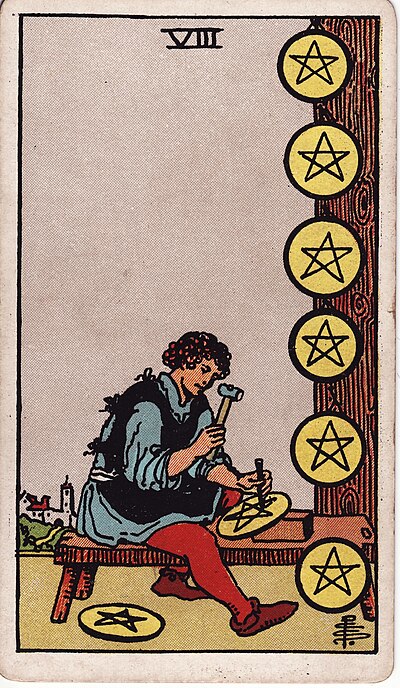
The Eight of Pentacles is a young craftsman on a bench, chisel in hand, carving a coin, with finished ones hung on a post beside him and one at his feet. The card is about diligence — the skill built one repetition at a time — and about the difference between mastery and going through the motions.
- Upright
- diligence · honing skill
- Reversed
- perfectionism · monotony
- In numerology
- Number 8
What the card shows
In the Eight of Pentacles a young man sits on a low wooden bench in the open, bent over his work, a hammer in one hand and a chisel in the other, carving a five-pointed star into a golden coin propped on the bench before him. Beside him a wooden post stands upright, and on it five finished coins hang in a column, each identical, each complete, and a sixth stands at its foot. A seventh lies on the ground by the bench, unfinished or waiting. He wears a blue tunic and a dark apron, and his attention is entirely on the coin in front of him. Behind him, at a distance across a yellow plain, a town shows its roofs and a church tower; he has come out here to work where nothing distracts. The sky is pale. Eight is the number of repetition, and the card shows exactly that: the same act done again and again until the hands know it.
Eight of Pentacles · Upright meaning
Upright, the Eight of Pentacles names the work of getting good at something — honing skill the only way it is ever honed: one coin at a time, each a little better than the last, with the finished ones hanging where they can be compared. The card's gift is diligence in its dignified form: attention that has become a practice, the apprenticeship that turns a job into a craft, the patience to do the small thing well when nobody is watching. It asks for the craftsman's posture — bent, absorbed, unhurried — and it rewards the person who takes pleasure in the repetition rather than only in the result. The card is honest that this stage is long and that most people leave it before it is finished. The shadow sits close to the gift. Repetition without attention is monotony; the eighth coin can be carved exactly like the seventh with nothing learned between them, and a person can hide in the craft the way others hide in the crowd, perfecting the small thing so as never to be tested on the large one. The town is a long way off, and he put it there. The card is not telling you that practice pays. It is asking what you are actually getting better at, whether each repetition is teaching you anything, and what the finished coins on the post are for.
In love
In love the Eight of Pentacles is the relationship worked at — the small daily attentions that add up, the partner who keeps learning the other person the way an apprentice learns a trade, the love that is a practice rather than a feeling. It favors steadiness over spark, and it is honest that steadiness can become routine if the attention goes out of it. Where a connection is new, the card asks what you are learning about this person that you did not know last month. Where it is older, it asks which of your habits together still have attention in them and which have become the seventh coin carved like the sixth. The reflection it offers: what skill have you built in loving this person — and when did you last try to get better at it on purpose?
In work and money
At work the Eight of Pentacles is the deliberate practice, the junior who does the hundredth version of the task with the same care as the first, the professional still improving twenty years into a career. It is a card of craft and diligence, and it is honest that craft is unglamorous, slow, and the only thing that reliably works. It rewards the person who chooses to master one thing over dabbling in six, and the manager who protects the time in which the coins get carved. Its question for the working week: what are you actually practicing at work — and are you getting better at it, or only getting through it?
What the card asks
Sit down at the bench and carve the next coin. Give it your whole attention, and when it is done, hang it beside the others and look at the difference. Do not go to the town yet; the work is here and it is not finished. But look up once an hour: mastery is for something, and the something is over there. Diligence is love made repetitive. Keep it love.
Eight of Pentacles · Reversed meaning
Reversed, the chisel slips or the hand goes numb. The Eight of Pentacles reversed describes perfectionism — the coin carved and recarved and never hung, the standard raised each time it is nearly met, the craftsman who cannot finish because finishing means being judged. Monotony is the other half: the eighth coin exactly like the seventh, the work done by hands the mind has left, the skill that has become a cage of competence. It can also show effort spent on the wrong craft, the years given to a technique nobody needed, or a person so tired of the bench that they have stopped caring whether the star is straight. All of these are the same card with the attention gone. The gift is still there, underneath — the hands still know what they know, and attention can be brought back to them. The reflection is not «work harder», which is the disease, but «what would be good enough — and who told you it was not?»
In love
Reversed in love, the Eight of Pentacles can describe the relationship that has become a set of routines performed without attention, or the partner who works so hard at being a good partner that the actual person disappears behind the effort. It may point to a perfectionism that finds fault in every coin, or to two people so diligent about the life they are building that they have stopped looking at each other. The question it leaves: are you practicing love with this person, or performing a technique — and would they know the difference?
In work and money
In work the reversed Eight of Pentacles is the report polished past the deadline, the expert who cannot delegate because nobody else does it right, the job that was a craft and is now a factory. It can be the person burned out by their own standards, or the one who has stopped caring about quality because caring was never noticed. The card asks whether your standards at work are serving the work or punishing you — and whether the coin you are carving still teaches you anything.
What the card asks
Hang the coin, even imperfect. If perfectionism has you, set a standard for good enough before you start the next piece, and stop when you reach it — the judgment you fear is not on the post; it is in your hands. If monotony has you, change one thing about the next repetition and see whether the attention comes back. If the craft is wrong, say so and pick up a different tool. The Eight of Pentacles reversed is not a lost craft. It is a reminder that repetition is only practice when something is learned, and that a finished coin teaches more than a perfect one.
Updated September 24, 2026