Minor Arcana · Swords
Seven of Swords
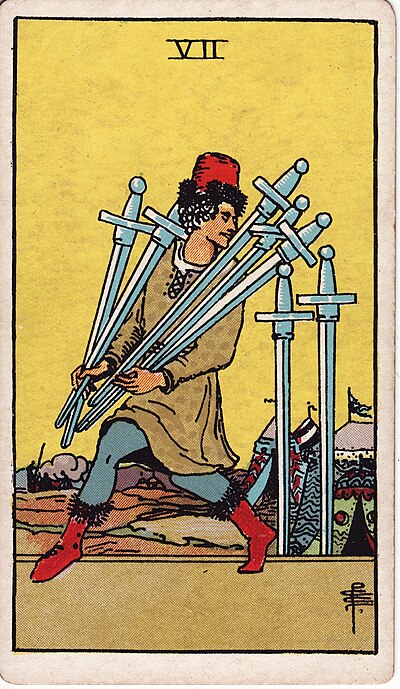
The Seven of Swords is a man tiptoeing away from a camp with five swords in his arms, two left standing in the ground, glancing back over his shoulder. The card is about strategy — the move made quietly, the truth managed rather than told — and about the difference between cleverness and honesty.
- Upright
- strategy · deception
- Reversed
- confession · coming clean
- In numerology
- Number 7
What the card shows
The Seven of Swords catches a man in a red cap and a patterned tunic moving away from a row of tents on tiptoe, carrying five swords bundled awkwardly in his arms. Two more swords stand upright in the ground behind him, left where they were. He looks back over his shoulder toward the camp with an expression of sly satisfaction, as though he expects to be seen and has decided that he will not be. In the far distance a few small figures stand, unaware. The ground is bare; the sky is yellow. He is not running — he is sneaking, which is slower and more deliberate. Seven is the number of the mind at work, and the card shows a mind at work in exactly the way the suit warns about: clever, quick, and carrying more than it can hold.
Seven of Swords · Upright meaning
Upright, the Seven of Swords names a strategy that depends on not being seen. Someone is moving cleverly — taking what they can carry, leaving what they cannot, timing the exit for when the camp is looking elsewhere. The card's gift, which is real, is exactly that cleverness: the resourcefulness to find the indirect route, the tact that says less than it knows, the strategic mind that does not announce every move. Not every silence is a lie; not every quiet exit is a theft. It asks you to know the difference, and it rewards the person who can be shrewd without becoming someone they would not trust. The shadow sits close to the gift, and on this card it is the foreground. Strategy shades into deception in a single step; the man is carrying five swords and has left two, which is to say he has taken more than his share and could not even manage that. Deception is also exhausting — the tiptoe, the glance back, the constant awareness of the camp. The card is not telling you that you are being deceived, or that you are deceiving. It is asking what you are carrying away quietly, what you are telling yourself about why, and who in the camp you are glancing back at.
In love
In love the Seven of Swords is the thing not said — the small dishonesty that keeps the peace, the message deleted, the strategy of managing a partner rather than meeting them. It is honest that every relationship has some tact in it and that tact is not betrayal; it is also honest that the line between them is walked on tiptoe. Where a connection is new, the card asks what you are presenting strategically and what you are hiding, and whether you know which is which. Where it is older, it asks what has been quietly carried out of the relationship — trust, attention, a piece of the truth — while the other person was looking elsewhere. The reflection it offers: if this person could see exactly what you are carrying right now, what would you have to explain?
In work and money
At work the Seven of Swords is the office politics done well and the office politics done badly — the idea taken credit for, the plan kept from the team until it is too late to object, the clever route around a process that existed for a reason. It is a card of strategy, and it is honest that strategy is necessary and that it corrodes when it becomes the whole job. It rewards the person who can be tactical about timing without being dishonest about substance, and who notices when they have started tiptoeing through their own workplace. Its question for the working week: what are you managing at work rather than saying — and whose camp are you glancing back at while you do it?
What the card asks
Count the swords in your arms. Keep the ones that are yours and put the others back; five is more than you can carry, and you know it. If a quiet route is genuinely wiser, take it — but take it walking, not tiptoeing, because the tiptoe is how you know something is wrong. Stop glancing back at the camp. If you cannot stop, that is the answer. Cleverness that has to hide is a debt with interest.
Seven of Swords · Reversed meaning
Reversed, the man turns around and walks back into the camp. The Seven of Swords reversed describes confession — the thing carried away brought back, the truth told before it is discovered, the deception ended by the deceiver — and it describes coming clean in the fuller sense: the relief of no longer having to hold five swords and a story about them. It can also show the exposure that was not chosen, the sneak caught mid-step, or the opposite: a person so used to the strategy that they confess strategically, telling a smaller truth to protect a larger lie. All of these are the same card with the tiptoe ended. The gift is still there, underneath — the mind that could plan the exit can plan the return, and honesty is also a strategy, only one that does not need a glance back. The reflection is not «you should be ashamed», but «what does it feel like to set the swords down — and how long had you been carrying them?»
In love
Reversed in love, the Seven of Swords can describe the confession that clears years of air, the partner who admits the small dishonesty before it becomes a large one, or the person who is finally caught and finds that being caught is a relief. It may also point to a coming clean that is only tactical, the truth told to manage the other person one more time. The question it leaves: what would you tell this person if you were sure of being forgiven — and why does the forgiveness have to be sure first?
In work and money
In work the reversed Seven of Swords is the mistake owned before the audit finds it, the credit given back, the plan finally shared with the people it affects. It can be the colleague who says «that was me» in the meeting where silence would have been easy. It can also be the exposure that ends a career built on tiptoe. The card asks for one honest look at what you have been carrying away from your workplace quietly — and at what it would cost, and what it would save, to walk it back in.
What the card asks
Turn around. Walk back to the camp with the swords in plain view and put them down where they were; the walking back is the whole of the courage the card asks for. If you have been caught, do not negotiate the story — tell it straight, once, and let the consequences be what they are. If you are confessing, confess the whole thing and not the tactical part. The Seven of Swords reversed is not humiliation. It is a reminder that honesty is the only strategy that does not need a glance over the shoulder, and that the camp is still there.
Updated September 23, 2026