Minor Arcana · Swords
Six of Swords
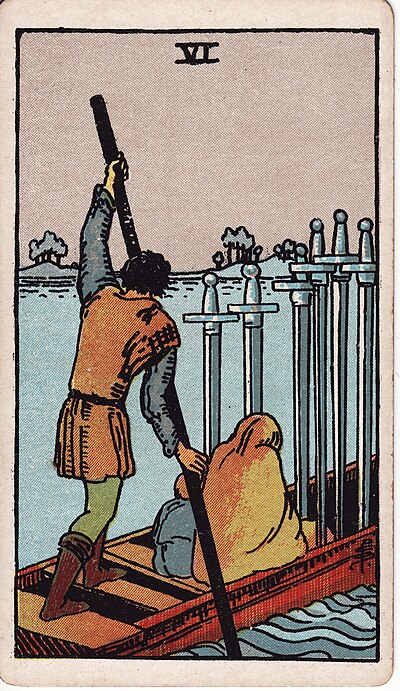
The Six of Swords is a boatman poling a small boat across still water, a hooded figure and a child aboard, six swords standing upright in the bow. The card is about transition — the crossing from one shore to another, quietly, with what you could carry — and about the difference between moving on and being carried.
- Upright
- transition · moving on
- Reversed
- resisting change · unresolved past
- In numerology
- Number 6
What the card shows
The Six of Swords is a crossing: a small boat moves over a stretch of water, poled from the stern by a standing figure. In the boat sit two passengers: an adult wrapped in a cloak with the hood drawn, head bowed, and a child pressed close beside them. Six swords stand upright in the bow of the boat, planted like a fence between the passengers and the far shore. The water on one side of the boat is rough; on the other, where they are heading, it lies smooth. That shore has trees and low land; the sky is pale and empty. Nobody speaks; nobody looks back. The passengers are not steering, and the boatman is not hurrying. Six is the number of harmony, and here it is the harmony of a quiet crossing — not joy, but the steadiness of a boat that is moving in one direction with everything it needs already aboard.
Six of Swords · Upright meaning
Upright, the Six of Swords names a passage. Something has been left and something else has not yet been reached, and the card's gift is the crossing itself: a transition undertaken with what could be carried, a movement away from the rough water toward the calm, the relief of being in motion after a long time of standing on the wrong shore. It is a card of moving on, and it asks for the passengers' posture — seated, quiet, not looking back, trusting the boatman and the pole — and it rewards those who can accept a change without needing it to feel triumphant. The card is honest that the crossing is somber: the swords come along, standing upright in the bow, and nobody in the boat is smiling. The shadow sits close to the gift. A passage can become a way of life; a person can be always in the boat, always between, never quite arriving because arrival would mean unpacking the swords. And the passengers are being taken, not steering — a transition that happens to you is not the same as one you chose. The card is not telling you that the far shore is better. It is asking what you are crossing away from, what you have brought with you, and whether you are the passenger or the one with the pole.
In love
In love the Six of Swords is the quiet leaving — the departure without drama, the relationship ended and mourned and now behind the boat, the two people who cross together into a different phase after something hard. It favors gentleness in transition, and it is honest that gentle transitions still carry their swords. Where a connection has ended, the card asks whether you have actually left the shore or are only sitting in the boat looking at it. Where a relationship continues through a change, it asks whether the two of you are in the same boat, and who is holding the pole. The reflection it offers: what are you carrying from the last shore into this one — and does the person beside you know what the swords are?
In work and money
At work the Six of Swords is the move between roles, the relocation, the quiet exit after the loud quarter, the team being ferried from the old system to the new with everything it could not leave behind standing in the bow. It is a card of managed transition, and it is honest that transitions are tiring and that the calm water is a destination, not a state. It rewards the person who can let a change be a change without narrating it as a defeat or a rescue, and the leader who steers steadily rather than announcing the shore. Its question for the working week: what transition are you in the middle of at work — and are you rowing it, riding it, or refusing to notice the boat has left?
What the card asks
Sit down in the boat. You have left the shore, and standing up to look back only rocks it. Bring the swords — you do not have to pretend the past did not happen — but keep them in the bow, planted, not in your hands. Watch the water change from rough to smooth, and let that be enough for today. If you are the one poling, pole steadily. If you are the passenger, let yourself be carried for one crossing without steering it.
Six of Swords · Reversed meaning
Reversed, the boat turns back or stalls in the middle. The Six of Swords reversed describes resisting change — the passenger who stands up, the shore clung to after it has been left, the transition fought so hard that the boat goes nowhere. It is also the card of the unresolved past: the swords pulled out of the bow and carried back into the new life, the old argument continued in the new house, the crossing made in body and not in mind. It can also show a person stranded between shores, unable to return and unwilling to arrive, a life lived in the boat. All of these are the same card with the crossing refused. The gift is still there, underneath — the calm water is where it was; the boat still floats. The reflection is not «let go of the past», but «what on the old shore are you still holding a rope to — and who is on the other end?»
In love
Reversed in love, the Six of Swords can describe someone who cannot leave the relationship they have already left, or the couple who moved cities and brought the same argument with them. It may point to a transition one partner has made and the other has not, so that they sit in the same boat facing opposite shores. The question it leaves: are you resisting this change because it is wrong, or because arriving would mean finally unpacking?
In work and money
In work the reversed Six of Swords is the reorganization fought long after it was decided, the employee who moved teams and keeps working for the old one, the migration to the new system that everyone quietly refuses to complete. It can be the person still litigating a career move that happened two years ago. The card asks what change at work you have been resisting — and whether the resistance is judgment or grief that has not been allowed to be grief.
What the card asks
Sit back down, and let the boatman finish the crossing. If you are resisting a change, name what you are afraid the far shore lacks, and check whether the old shore actually had it. If you are carrying the past in your hands instead of the bow, set it down where it can be seen and not swung. If you have been living in the boat, pick a shore — either one — and step onto it. The Six of Swords reversed is not a failed crossing. It is a reminder that the water was always going to be crossed, and that the only question left is whether you arrive.
Updated September 23, 2026