Minor Arcana · Swords
Five of Swords
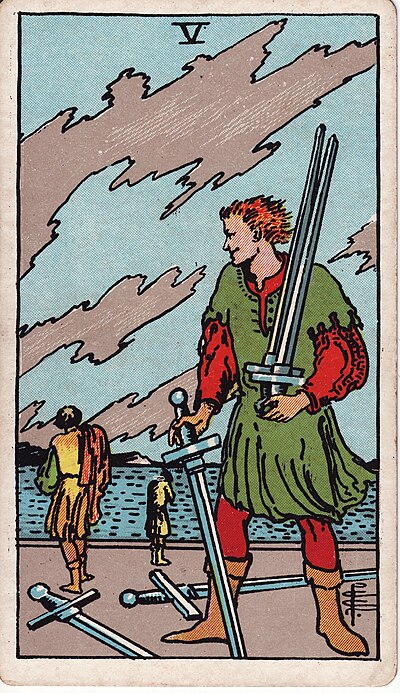
The Five of Swords is a man with three swords and a smirk, looking back at two figures walking away, two more swords left on the ground. The card is about conflict that someone won, and what the winning cost — and about the difference between victory and having the field.
- Upright
- conflict · hollow victory
- Reversed
- reconciliation · grudge released
- In numerology
- Number 5
What the card shows
The young man in the foreground of the Five of Swords holds three swords — two slung over his shoulder, one gripped in his hand — and looks back over his shoulder with an expression of satisfaction that does not quite reach his eyes. Two more swords lie on the ground at his feet. Behind him, two figures walk away toward the sea, one with his head in his hands, the other with shoulders bowed; neither looks back. The sky is full of jagged, wind-torn clouds, and the sea beyond is choppy. The ground is bare. Nobody is bleeding, but two people have left the field without their weapons, and one has them all. Five is the number that breaks the square of four, and the card shows the break as a fight that ended — with a winner, and with nothing else in the picture worth having.
Five of Swords · Upright meaning
Upright, the Five of Swords names a conflict that has been won and has cost more than it looks. Someone has the swords; someone else has walked away; and the card's gift is the honesty of showing both — the victory and the empty field it was won on, the smirk and the two backs turned to it. It is a card of conflict, of ambition that did not check its methods, of the argument won by being the last one standing, and it asks you to look at what winning actually consisted of. It rewards the person who can tell a hollow victory from a real one while still holding the swords. The card is honest that sometimes the fight had to be had, and that a boundary defended is not a crime. The shadow sits close to the gift, and on this card it is the whole foreground. A person who wins this way learns to fight this way; the field is theirs and nobody is on it, and the swords they collected were never theirs to keep. The card is not telling you that you were wrong to fight. It is asking what you won, what it cost the people walking away, and whether you would rather have the swords or the company.
In love
In love the Five of Swords is the argument won at the price of the relationship — the point proven, the partner silenced, the field cleared and the bed cold. It is honest that conflict is part of every real connection and that winning is not. Where a connection is new, the card asks whether you are already keeping score, and what you are hoping to win. Where it is older, it asks which fights between you have been won by one person and lost by both, and how many swords you are each still carrying from them. The reflection it offers: when you last won an argument with this person, what did you do with the victory — and did it keep you warm?
In work and money
At work the Five of Swords is the promotion taken by undercutting a colleague, the meeting won by humiliating the person who disagreed, the negotiation that got everything and left the other side never wanting to deal with you again. It is a card of ruthless competition and its aftermath, and it is honest that some workplaces reward exactly this until the day they do not. It rewards the person who can build a career without collecting everyone else's swords, and who notices when a victory has emptied the room. Its question for the working week: what have you won at work recently — and who walked off the field afterward, and would they come back?
What the card asks
Put two of the swords down. Keep the one that was yours, and look honestly at the other two — they belong to people who are walking away, and carrying them does not make you stronger. If the fight was necessary, let it be over; if it was not, notice that too. Then look at the sky rather than the field. A victory that leaves you alone with the weather is worth exactly what the weather is worth.
Five of Swords · Reversed meaning
Reversed, the man puts the swords down or the walkers turn back. The Five of Swords reversed describes reconciliation — the conflict ended not by a winner but by two people who decided the field was not worth it, the apology made or accepted, the grudge released — and it describes the moment a fighter notices the cost and chooses to stop paying it. It can also show a surrender that is really an accumulation: the swords handed over with a smile and the resentment kept, or the reconciliation that is only a truce until the next weather. All of these are the same card with the fight over and the outcome not yet clear. The gift is still there, underneath — the same sharpness that won can be used to see what winning cost. The reflection is not «make peace», but «what would you have to give up to actually end this — and is it the swords, or the being right?»
In love
Reversed in love, the Five of Swords can describe two people who put down the score after years of keeping it, or the person who finally lets go of a grudge that had become the relationship's third member. It may point to a reconciliation that is real, or to one in which the swords are hidden rather than dropped. The question it leaves: are you releasing this, or storing it — and would the other person be able to tell?
In work and money
In work the reversed Five of Swords is the rivalry ended by a handshake that means something, the colleague who apologizes after the meeting, the team that stops keeping a ledger of who won what. It can also be the false peace — the concession made in the room and the knife kept for the corridor. The card asks for one honest look at what grudges you are still carrying at work — and at whether releasing them would cost you anything but their weight.
What the card asks
Drop the swords on the ground and leave them there. If reconciliation is possible, offer it without a scoreboard — the apology that lists the other person's faults is another sword. If a grudge has been living in you, decide whether it has earned its rent, and if not, evict it plainly. If you are being offered peace, check that you are not accepting it only to reload. The Five of Swords reversed is not losing. It is a reminder that a field with people on it is worth more than a field full of blades, and that the walk back is allowed.
Updated September 23, 2026