Minor Arcana · Wands
Five of Wands
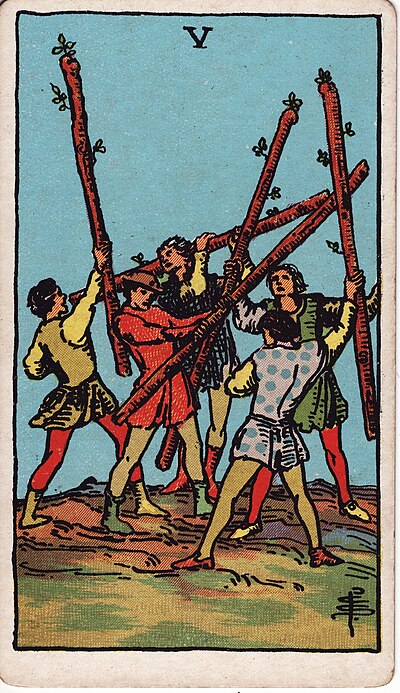
The Five of Wands is five young men with staves raised, striking and blocking in a tangle where nobody seems to be winning or hurt. The card is about friction — the competition of wills that produces heat without yet producing direction — and about the difference between a fight and a contest.
- Upright
- competition · friction
- Reversed
- tension released · conflict avoided
- In numerology
- Number 5
What the card shows
In the Five of Wands, five young men stand on open ground, each with a long wooden staff, and the staves cross in the middle of the picture in a knot of raised arms. Their clothes are all different — one in yellow, one in red, one in green, one in white dotted with blue — so that no two of them are on a team. Nobody is bleeding; nobody has fallen. It is not clear whether they are fighting or practicing, whether the staves are aimed at each other or simply in each other's way. The sky is clear blue, the ground bare. Every wand still has its leaves. Five spoils the neat square of four, and here that is literal: the order of the garland gone, and something noisier in its place.
Five of Wands · Upright meaning
Upright, the Five of Wands names a time of friction. Wills clash — in a meeting, in a household, inside one person's own head — and the card's gift is the honesty that this heat is not always harm. Competition sharpens; disagreement surfaces what agreement was hiding; five people with five ideas are, at least, five people who care. It asks you to see the contest as a contest, to take the staff up without needing anyone to fall, and it rewards those who can argue without making it personal and lose a round without making it a war. The shadow sits close to the gift. Friction that goes nowhere becomes a habit; the group that only ever crosses staves never builds anything with them, and a person can mistake the noise of conflict for the feeling of being alive. The card is not telling you who is right. It is asking what the fight is actually about — the thing named, or the standing — and whether the five of you are trying to win something, or only trying not to lose.
In love
In love the Five of Wands is the argument that clears the air and the argument that only stirs it — the couple who spar because it is how they engage, the rivalry between two people who want the same person, the friction of two strong wills in one kitchen. It is honest that conflict can be a form of attention, and that some relationships run on it. Where a connection is new, the card asks whether the sparks between you are heat or only noise. Where it is older, it asks what the two of you fight about most, and what that fight stands in for. The reflection it offers: when you cross staves with this person, are you trying to be understood, or trying to win?
In work and money
At work the Five of Wands is the brainstorm that turns into a shouting match, the team of talented people who cannot agree on a direction, the rivalry between departments that everyone calls healthy and nobody enjoys. It is a card of competition, and it is honest that competition can produce both the best ideas and the worst afternoons. It rewards the person who can hold the staff firmly and still hear the others, and the manager who turns five arguments into one decision. Its question for the working week: what conflict at work keeps recurring without resolving — and what would it take to make it a contest with rules rather than a melee?
What the card asks
Pick up the staff, but know what it is for. Argue the point, not the person; lose a round on purpose and see what it costs. If the friction has energy in it, use it — the heat that comes from five opinions can be pointed at a problem. If it is only noise, step out of the knot for a moment and watch who is actually fighting whom. The wands are still green. Nobody has to be beaten for something to be built.
Five of Wands · Reversed meaning
Reversed, the staves of the Five of Wands come down. Tension is released — the argument ends, the rivalry loses its point, the five find they were on the same side after all — and the card describes the relief of a conflict resolved or simply set aside. It can also describe conflict avoided at a cost: the disagreement swallowed to keep the peace, the room in which nobody argues because nobody says anything real. Both are the same card with the noise gone, and only one of them is quiet for a good reason. The gift is still there, underneath — the energy that was in the fight does not vanish when the fight does; it goes somewhere. The reflection is not «keep the peace», but «what did you do with the heat when you put the staff down — and did you put it down, or hide it?»
In love
Reversed in love, the Five of Wands can describe the moment two people stop sparring and find out what is underneath, or the couple who have stopped fighting because they have stopped engaging. It may point to a rivalry that dissolves, or to a disagreement so carefully avoided that it has become the loudest thing in the room. The question it leaves: is the quiet between you the peace after an argument, or the silence instead of one?
In work and money
In work the reversed Five of Wands is the team that finally agrees on a direction, or the team in which nobody disagrees anymore because disagreeing has become a career risk. It can be the rivalry that ends in a merger of ideas, or the meeting in which the real objection is raised afterward, in the corridor. The card asks how conflict ended in your workplace — whether it was resolved, or whether it went underground.
What the card asks
Lower the staff, and then check that the argument is actually over. If a conflict has genuinely resolved, mark it — say what was settled and how. If you have been avoiding one, raise the real point once, calmly, and let the room have it. The energy that went into the fight is still yours; give it a job. The Five of Wands reversed is not an end to disagreement. It is a reminder that a released tension has to go somewhere, and that the quietest room is not always the most peaceful one.
Updated September 23, 2026