Major Arcana
The Hierophant
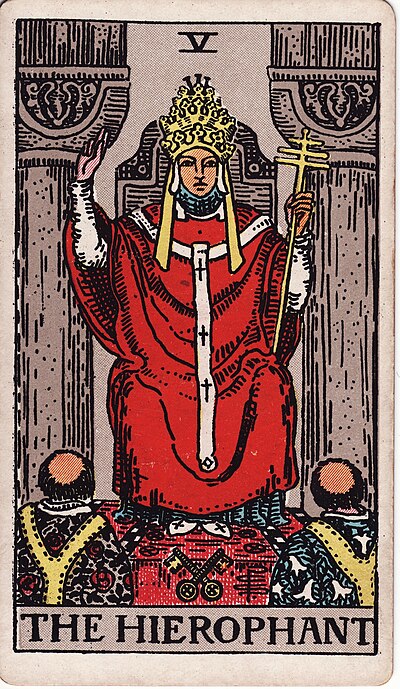
The Hierophant sits between two pillars in a formal setting, a triple crown on his head, two acolytes kneeling before him, two crossed keys at his feet. Where the Emperor rules by structure he alone sets, the Hierophant teaches structure that came from somewhere older than him — a tradition, a shared method, a community with its own way of doing things. The card is about learning inside a lineage rather than inventing everything from scratch, and about knowing when that lineage is still worth trusting.
- Upright
- tradition · guidance · learning
- Reversed
- dogma · rebellion · unconventionality
- In numerology
- Number 5
What the card shows
The Hierophant sits enthroned between two gray pillars, dressed in the layered robes and triple-tiered crown of a religious office, a triple cross staff held in one hand. His right hand is raised in the two-fingered gesture of a blessing, addressed outward to whoever is watching rather than to no one. Two acolytes kneel before him, their backs patterned with roses and lilies — the same flowers, differently arranged, that the Magician grew alone. At his feet, two keys lie crossed: gold and silver, the kind that open something rather than lock it. Everything about the scene is formal, repeatable, built to be performed the same way by whoever holds the office next — this is a card about a role, not only the person currently in it.
The Hierophant · Upright meaning
Upright, the Hierophant is what a person learns by joining something larger than themselves rather than working it out alone — a discipline with its own history, a mentor further along a path than the reader, a community that has already solved problems the reader has not encountered yet. What it hands the reader is the shortcut built into tradition: centuries of trial folded into a method, so the reader does not have to rediscover every mistake in person. It favors structured learning, formal commitment, and respect for the people who came first. The shadow is the same institution, followed after it has stopped teaching anything — ritual kept for its own comfort, belief performed rather than held, obedience to «how it is done» offered instead of a real answer to «why». The two crossed keys can open a door or simply hang there as decoration on someone who has stopped using them. The question worth asking: is the tradition or teacher you are following here still opening something for you, or are you keeping the form after the substance left it?
In love
In love the Hierophant can mean a relationship built on shared belief or ritual — a faith held together, a family tradition both people want to keep, a wedding, a formal commitment made in front of others rather than only between two people. It favors partnerships that draw on something established: a template neither person has to invent alone. Its reflection: what shared structure — a value, a practice, a community — is actually holding this relationship together, and does it still fit both of you as written?
In work and money
At work the Hierophant favors the established career path — a certification, a mentor, an apprenticeship, learning the accepted method before trying to improve on it. It suits situations where following a known process actually saves real cost later, and where a more experienced person's guidance is worth the discomfort of being taught. Its question for the working week: whose experience are you refusing to learn from, out of a preference for figuring it out yourself?
What the card asks
Find the person or method that has already solved a version of this, and study it honestly before improvising past it. Join the structure before you decide it is wrong for you. And keep the keys in use — a tradition is worth its formality only as long as it still opens something real for the people inside it.
The Hierophant · Reversed meaning
Reversed, the Hierophant can mean two very different failures wearing the same robe. One is dogma: a belief, a method, or an authority followed without question long after it stopped fitting the situation, obedience mistaken for wisdom. The other is its mirror — unconventionality kept up as a small rebellion against every structure on principle, refusing guidance that would actually help simply because it came from an institution rather than from the reader alone. Both waste the same keys: one by never trying them, the other by refusing to pick them up at all. The two acolytes are missing from the reversed picture, in a sense — nobody is present to receive what is being offered, whichever direction the offering came from. The reflection: which of the two failures does this situation actually look like?
In love
Reversed in love, the Hierophant can mean a relationship strained by rules neither person actually agreed to — inherited expectations from family or culture followed out of habit rather than genuine belief. It can equally mean rejecting a workable tradition — marriage, a shared practice, a community — purely because it looks conventional. The question: is the structure here truly wrong for you both, or simply unexamined?
In work and money
In work the reversed Hierophant often names credentialism without substance — following procedure for its own sake, or a mentor whose advice has calcified into rules that no longer match the situation. It can also mean refusing all guidance out of stubbornness, repeating solvable mistakes that a little humility would have avoided. The card asks you to look honestly at which mistake is currently yours.
What the card asks
If the reversed Hierophant has you following a rule past its use, name out loud what it was originally for, and check whether that reason still applies. If you have been refusing guidance on principle, pick one piece of established wisdom you have been resisting and actually try it once, properly, before rejecting it for good. Either way, look directly at the keys in front of you rather than at the crown. The Hierophant reversed is not a loss of faith. It is a reminder that a tradition is a set of keys, and that a key is judged by what it opens, not by who is holding it.
Updated September 24, 2026