Major Arcana
The Emperor
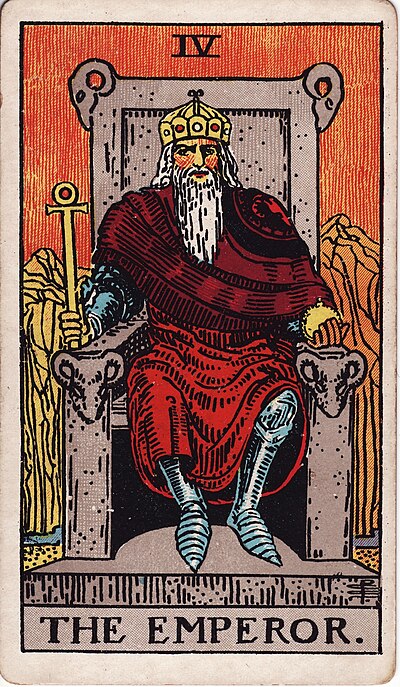
The Emperor sits on a stone throne carved with ram's heads, armor showing beneath his robe, mountains behind him instead of the Empress's living field. He holds an ankh and an orb — life, held inside order. The card is about structure that makes something possible: a boundary, a schedule, a rule that exists so the people living under it do not have to negotiate everything from scratch. Its shadow is the same structure grown rigid past the point where it still serves anyone.
- Upright
- structure · authority · stability
- Reversed
- rigidity · domination · lack of discipline
- In numerology
- Number 4
What the card shows
The Emperor sits squarely on a throne of gray stone, upright where the Empress reclined, four ram's heads carved into its arms and back — Aries, the sign of beginnings pushed by force rather than allowed to ripen. Armor is visible at his ankle beneath the robe: authority backed by the readiness to defend it, not only the appearance of it. In one hand he holds an ankh, the sign of life; in the other, a golden orb, small enough to fit in a fist. Behind him the mountains are bare and exact, none of the Empress's river or wheat — this is a landscape shaped by will rather than grown by season. His beard is long, his gaze level and unmoved.
The Emperor · Upright meaning
Upright, the Emperor is the deck's argument for structure: the boundary, the rule, the plan written down so it does not have to be re-decided every day. What he offers is stability built on purpose — a home, a project, or a life organized well enough that the people inside it can stop bracing for chaos and start building on solid ground. Where the Empress grows a thing by giving it room, the Emperor grows it by giving it a shape it can hold. The shadow sits in the same stone throne: structure that has stopped answering to anyone, a rule enforced because it is the rule rather than because it still serves the people under it. The ram's heads carved into the throne can mean force used to protect what matters, or force used simply because it is available. The Emperor does not soften this distinction for you. The question the card leaves: is the order you are keeping here still working for the people inside it, or only for the order itself?
In love
In love the Emperor is the relationship that runs on clear terms — plans that are kept, boundaries that are named instead of implied, a partner who can be counted on to show up the way they said they would. It favors consistency over intensity and commitment stated plainly over romance left to guesswork. Where the structure has become control rather than reliability, the card is exact about the difference. Its reflection: does the order in this relationship make room for the other person, or only for your version of how things should go?
In work and money
At work the Emperor is the plan that holds, the process that exists because the last three times without one went badly, the leader who is respected because they are consistent rather than because they are liked. It suits negotiating terms, setting a boundary with a client, mapping the next stage of a career, or finally writing down the rule everyone has been enforcing informally. Its question for the working week: what here needs a clearer structure, and are you willing to be the one who sets it?
What the card asks
Build the structure before you need it, not during the crisis that proves you needed it. Say the boundary out loud instead of expecting it to be inferred. And test your own rules occasionally against the people they govern — a throne that has not been reconsidered in a long time is usually overdue for it.
The Emperor · Reversed meaning
Reversed, the Emperor's order has hardened into rigidity, something that no longer bends for the people it was meant to serve — a rule kept for its own sake, a plan followed past the point it stopped making sense, domination where there was meant to be authority, a leader mistaking obedience for respect. It can also describe the opposite failure, a lack of discipline: no rules at all, boundaries never set, a situation left to organize itself and doing so badly. Both are the same throne, occupied wrongly in different directions. The mountains behind him have not moved; what has slipped is the reason the order was built in the first place. The reflection is not «rules are bad» — it is «which of your rules are still doing the job you built them for?»
In love
Reversed in love, the Emperor can mean control mistaken for care — decisions made unilaterally «for the relationship's own good», or a partner who cannot tolerate a plan changing once it is set. It can equally mean the opposite: no agreed terms at all, both people improvising a relationship neither has actually described out loud. The question: has structure here become a wall, or is the real problem that there is none?
In work and money
In work the reversed Emperor often names authority exercised for its own sake — a manager who confuses control with leadership, or a process kept because changing it would be an admission that it was wrong. It can also mean a team with no structure at all, reinventing its basic decisions every week. The card asks which direction your own situation has actually tipped toward before you try to fix it.
What the card asks
If the Emperor reversed finds you holding the structure too tightly, loosen one rule on purpose and watch what actually happens — it is rarely as bad as the throne makes it feel. If the problem is the opposite, write down one boundary today and say it out loud to the person it concerns. Either way, the fix is the same size: one deliberate adjustment, not a full rebuild of the mountain. The Emperor reversed is not a fallen throne. It is a reminder that a structure is kept by the hand that adjusts it, and that a rule nobody reconsiders is only a habit wearing a crown.
Updated September 24, 2026