Major Arcana
Death
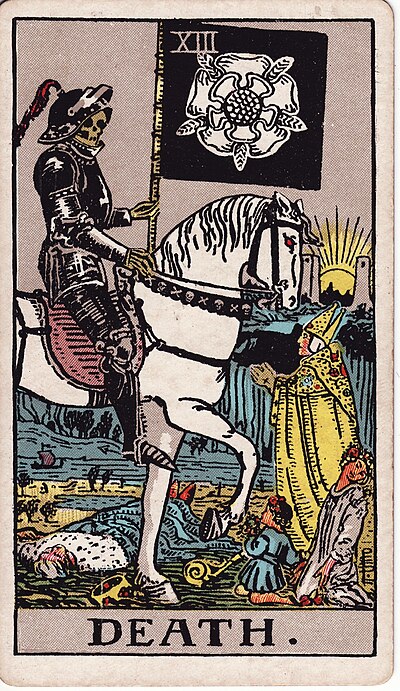
Death rides a white horse in black armor, carrying a banner with a white rose, and a king lies fallen beneath the hooves. The card is about endings — the transformation that only begins when something is truly released — and about the difference between what is dying and what is merely changing shape. It is not a card about anyone dying.
- Upright
- endings · transformation · release
- Reversed
- fear of change · clinging to the past · stagnation
- In numerology
- Number 4
What the card shows
Death, a skeleton in black armor, rides a white horse across a field where a king lies dead, his crown fallen. A bishop in yellow robes stands with hands raised, pleading or blessing; a woman turns her face away; a child kneels and holds out flowers, unafraid. The rider carries no weapon — only a black banner with a white five-petaled rose, a very old sign for life that continues. Behind them a river flows, a boat on it, and between two distant towers the sun stands on the horizon; the picture does not say whether it is rising or setting. The number is thirteen, the one nobody wanted, and the card wears it without apology.
Death · Upright meaning
Upright, Death names an ending that is real. Something has finished — a role, a phase, a belief about yourself, a way of living that no longer fits — and the card's gift is the honesty of saying so: no more tending what is already gone, no more standing at the bedside of a thing that has stopped breathing. It asks for release rather than repair, the courage to let the old form drop so the transformation underneath it can show. The white rose on the banner is the point: something continues, but only past the ending, not around it. The shadow sits close to the gift. The card can be read as permission to burn everything, and an ending performed for drama is not the same as one that was true. The card is not telling you what is over. It is asking what you already know has ended, and what you are still carrying to its door.
In love
In love, Death is the end of a chapter rather than always the end of the story — the version of a relationship that cannot continue, the pattern between two people that has to die for the people to live. It can describe a breakup that has already happened in every way but words, or a marriage that has quietly become a different marriage and needs to be recognized as one. It favors the honest funeral over the long haunting. Where a connection is new, the card asks what you are bringing to it from something that ended badly. The reflection it offers: what in this relationship deserves to be mourned, so that the rest of it can be lived?
In work and money
At work Death is the project that should be closed rather than rescued, the role that has run its course, the company that is becoming something else and cannot go back. It is a card of endings that clear the field, and it is honest that the field looks bare for a while afterward. It rewards the person who can say «this is finished» a season before everyone else does, and who does not mistake sentiment for strategy. Its question for the working week: what are you keeping alive at work because ending it would mean admitting it ended?
What the card asks
Let it be over. Say the ending in plain words, to yourself first. Hold the funeral properly — grief is part of the card, not a failure of it — and then look at the horizon, where the sun is doing something you cannot yet name. Carry the banner and not the crown: what continues is not the form, but the life that was in it.
Death · Reversed meaning
Reversed, Death rides up and is refused. Fear of change holds the old form in place long after it has stopped serving; the past is clung to with both hands, and stagnation sets in — not peace, but a kind of holding of breath. The king is propped up on his throne and everyone agrees to pretend. Or the card shows an ending that is happening anyway, slowly and badly, because it was not allowed to happen cleanly. Both are the same card unbalanced: a transformation delayed until it becomes decay. The gift is still there, underneath — the life that wants to continue and is waiting for room. The reflection is not «let go», said flatly, but «what do you think is protected by keeping this alive?»
In love
Reversed in love, Death can describe a relationship kept going by fear of the empty room, or a grief for an old love that has not been allowed to finish and so colors every new one. It may point to a person who changes nothing and hopes the feeling comes back, or to an ending that keeps being un-ended by one more message. The question it leaves: is this still alive, or are you afraid of what you would have to become without it?
In work and money
In work, Death reversed is the legacy system nobody can switch off, the role that exists because it always has, the reorganization announced three times and never done. It can be the career held in place by the fear that any move is a fall. Or it is the ending that was decided and is being carried out so slowly that it hurts more than the clean cut would have. The card asks for one honest look at what has already died in your work, and for a date on which you stop feeding it.
What the card asks
Loosen one hand. You do not have to end everything today; you have to stop pretending the thing that ended is still here. If you have been clinging, choose one small ritual of release — a file archived, a conversation had, a door closed. If you have been decaying instead of deciding, decide. Death reversed is not a threat. It is a reminder that what refuses to die does not get to live either, and that the river in the picture is still moving.
Updated September 23, 2026