Major Arcana
The Hanged Man
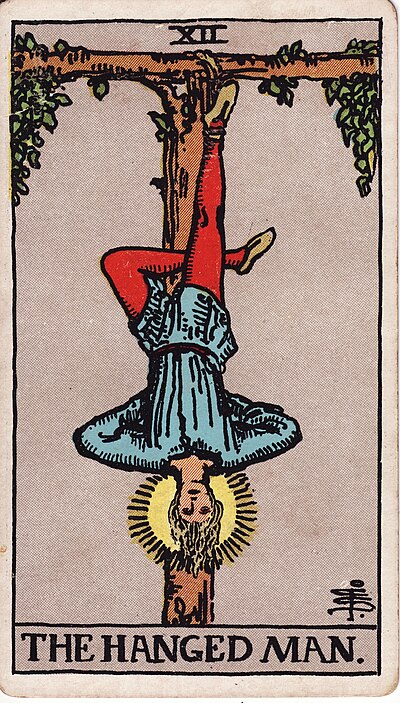
The Hanged Man hangs upside down from a living tree by one foot, hands behind his back, and his face is calm. The card is about the pause that changes what you can see — surrender not as defeat but as a new perspective — and about the difference between waiting on purpose and simply being stuck.
- Upright
- pause · surrender · new perspective
- Reversed
- stalling · resistance · sacrifice in vain
- In numerology
- Number 3
What the card shows
The Hanged Man, a young figure, hangs by his right ankle from a T-shaped beam of living wood — the tree still has leaves — with his left leg folded behind the right to make the shape of a four. His arms are behind his back; from the front he seems to make a triangle beneath the cross of his legs. Around his head there is a glow, the same light the deck gives to saints. His face is not in pain. He is not struggling, and nothing holds his hands. The picture makes one thing plain: he could climb down, and he has not. The number is twelve, a full turn of the clock — an hour that is not passing but being spent.
The Hanged Man · Upright meaning
Upright, the Hanged Man names the pause that has a purpose. Something has stopped — a plan on hold, a decision that refuses to be made, a season of waiting that was not chosen — and the card's gift is what the stop makes possible: the world seen from the other way up, the priorities that reorder themselves when you cannot act on any of them, the surrender that turns out to be a kind of attention. It asks you to stay in the suspended place a little longer than is comfortable, because the new perspective is not available from the ground. The shadow lives close to the gift. A pause can become a posture; surrender can become the excuse for never choosing, and a person can be so proud of their patience that they forget it was supposed to end. The card is not telling you to wait. It is asking what you can see from here that you could not see standing up.
In love
In love the Hanged Man is the space between the question and the answer — the willingness to let a relationship be unresolved for a while rather than forcing it into a shape. It can describe giving something up for someone without keeping the receipt, or seeing a partner from an angle that makes an old argument look different. Where a connection is new, the card asks whether you are waiting for the other person or waiting for yourself. Where it is older, it asks what you have been holding onto so tightly that letting go looks like loss when it might be relief. The reflection it offers: what would this relationship look like if you stopped trying to steer it for a week?
In work and money
At work the Hanged Man is the project deliberately paused, the decision postponed until the missing fact arrives, the week spent looking at the problem from the customer's side instead of the team's. It is a card of perspective rather than progress, and it is honest that perspective looks like idleness from a distance. It rewards the person who can tolerate not knowing long enough to know properly. Its question for the working week: what are you pushing forward that would answer itself if you let it hang for three days?
What the card asks
Stay upside down a little longer. Put your hands behind your back on purpose and notice what your mind does when it cannot fix anything. Let one thing go that you have been carrying only because putting it down felt like failing. And set a limit — a date, a condition — so that the pause remains a choice rather than a place you live.
The Hanged Man · Reversed meaning
Reversed, the Hanged Man's rope holds but the purpose is gone. The pause becomes stalling: the decision put off again, the perspective never actually used, the sacrifice in vain — made, and then resented because nothing came of it. Or the card shows the other failure — resistance to any surrender at all, the person who cannot bear to hang for a moment and so never sees anything but the ground they are standing on. Both are the same card unbalanced: suspension without meaning, or motion without sight. The gift is still there, underneath — a real need to stop and look that has lost its shape. The reflection is not «get moving», but «what were you waiting to see, and have you seen it?»
In love
Reversed in love, the Hanged Man can describe a relationship held in limbo by one person's refusal to decide, or a giving-up that was supposed to be generous and has turned into a grievance. It may point to a martyrdom that keeps score, or to a stubbornness that refuses to try the other angle even once. The question it leaves: are you waiting for this to become clear, or waiting so that you never have to choose?
In work and money
In work the reversed Hanged Man is the pause that has become a permanent state — the decision «under review» for a quarter, the career on hold for a year, the strategy nobody commits to, the effort poured into a thing that everybody privately knows has ended. Or it is the refusal to pause at all: the team that ships to avoid thinking. The card asks for one honest look at what the delay is protecting, and whether the cost of hanging has passed the value of what was seen.
What the card asks
Check whether the rope is still holding anything. If you have been stalling, name the decision you are avoiding and give it a day. If you have been resisting, hang for one hour on purpose — no plan, no fix — and see what the room looks like from there. The Hanged Man reversed is not a verdict of futility. It is a reminder that a pause is a thing with an end, and that the ending is yours to call.
Updated September 24, 2026