Minor Arcana · Swords
Three of Swords
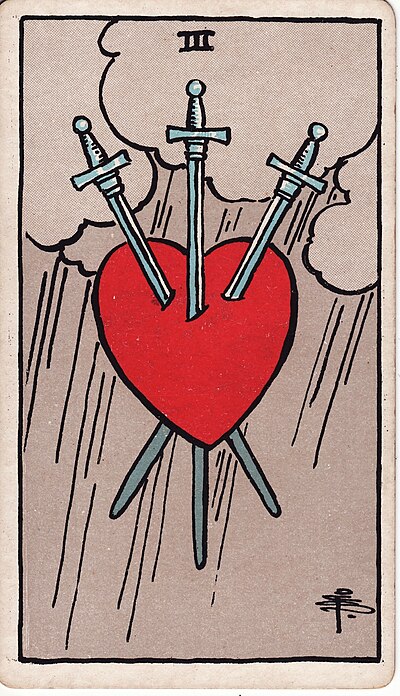
The Three of Swords is a red heart pierced by three swords against a gray sky full of rain, with no one in the picture at all. The card is about heartbreak — the pain that is exactly what it looks like — and about the difference between a wound that is named and one that is carried.
- Upright
- heartbreak · painful truth
- Reversed
- healing · forgiveness
- In numerology
- Number 3
What the card shows
In the Three of Swords a red heart, large and plain, hangs in the center of the picture, and three straight swords pass through it — one from above, two from either side at an angle — their points emerging below. Behind it the sky is gray with heavy cloud, and rain falls in straight lines across the whole card. There is no hand, no figure, no landscape, no ground: only the heart, the blades, and the weather. It is one of the simplest pictures in the deck, and one that needs no explanation. Three is the number that makes a shape, and here the shape is three wounds in one place — the card the suit of air uses to show what a thought can do to a heart.
Three of Swords · Upright meaning
Upright, the Three of Swords names a pain that is real and specific. Something has gone through the heart — a betrayal, a loss, a truth that could not be unsaid — and the card's gift is honesty: no disguise, no consolation offered too early, no pretending the swords are anything but swords. The rain falls and the heart is pierced, and that is what has happened. It asks you to name the wound precisely — which sword, from which direction, held by whom — and it rewards the person who can grieve a specific hurt rather than bleeding in general. The card is honest that this is the beginning of healing and not its opposite: a wound that is seen can close, and one that is denied stays open under the shirt. The shadow sits close to the gift. Pain that is named can become pain that is worn — the heart displayed with its swords as identity, the grief kept fresh because it has become a way of being seen. The card is not telling you that you have been wronged. It is asking what has actually pierced you, whether you have let yourself feel the specific hurt rather than a general one, and whether the rain in the picture is still falling or is something you are remembering.
In love
In love the Three of Swords is the card nobody wants and everybody recognizes — the affair discovered, the sentence that ended it, the moment a person you trusted said the thing that could not be unheard. It is a card of heartbreak in the plainest sense, and it is honest that some breaks are total and some are what a heart looks like when it is being told the truth. Where a connection has ended, the card asks whether you are grieving the person or the version of yourself that trusted them. Where a relationship continues after a wound, it asks whether you have faced the swords together or agreed to leave them in. The reflection it offers: which of the three swords is the one you cannot stop touching — and who put it there, honestly?
In work and money
At work the Three of Swords is the betrayal by a colleague, the layoff announced by someone you had trusted, the project killed with a sentence, the painful truth in the review that turned out to be right. It is a card of professional hurt, and it is honest that work can wound and that the wound is not less real for happening in a meeting room. It rewards the person who can name what hurt and why, rather than turning it into a story about the whole company. Its question for the working week: what at work has gone through you recently that you have been treating as a scratch — and what would it mean to call it what it was?
What the card asks
Look at the heart. Name each sword — what it was, who held it, what it cut — and do not rush to pull them out before you have seen them. Let the rain fall; it is the weather of the card and it is not a failure. Then notice that there is no one else in the picture. The heart is the subject, not the wound. Grieve the specific thing, and let it be specific.
Three of Swords · Reversed meaning
Reversed, the swords are drawn out and the rain thins. The Three of Swords reversed describes healing — the wound that has been seen closing, the pain that has become a scar rather than a bleeding, the ability to think about what happened without the sky going gray. It is also a card of forgiveness: not the forgetting, but the setting down of the swords so they no longer have to be carried in the heart of the person they were used on. It can also show the wound refused — the heart that will not look at its swords and so cannot heal around them, the old hurt that keeps being reopened by a new small thing. Or a forgiveness declared too early, the swords covered with a bandage before the cut was cleaned. All of these are the same card in the season after. The gift is still there, underneath — a heart that has been pierced and has closed knows something about itself that an unpierced one does not. The reflection is not «let it go», but «what did each sword teach you, and are you carrying the lesson or still the blade?»
In love
Reversed in love, the Three of Swords can describe the slow recovery from a heartbreak — the first week the person is not the first thought, the ability to say their name — or a forgiveness that has genuinely happened between two people who stayed. It may point to a wound that was never allowed to close, reopened in every new relationship, or to an old hurt finally released. The question it leaves: are you healing from this person, or healing from what you decided about yourself because of them?
In work and money
In work the reversed Three of Swords is the team that has recovered from a betrayal and can talk about it, the professional who left a wounding workplace and has stopped flinching, the painful review that has become a change rather than a scar. It can also be the grudge carried from job to job across a career, coloring every new manager with the old one's face. The card asks for one honest look at what work-wound you are still carrying — and at whether the blade is still in, or only the memory of it.
What the card asks
Draw one sword out, slowly. If you are healing, let the scar be a scar — visible, closed, not a thing to keep testing with your thumb. If you are ready to forgive, forgive the specific act and not the whole person or the whole past; smaller forgivenesses are the ones that hold. If the wound will not close, ask whether you have actually looked at it, or only felt it. The Three of Swords reversed is not the pain undone. It is a reminder that a heart heals from the outside in, and that the rain does stop.
Updated September 23, 2026