Minor Arcana · Swords
Four of Swords
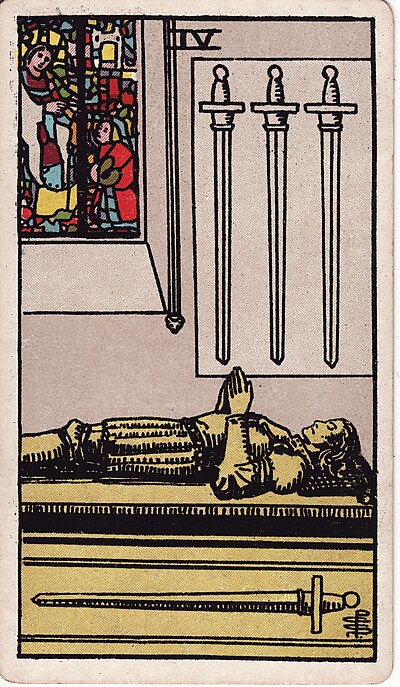
The Four of Swords is a knight lying in stone on a tomb, hands folded in prayer, three swords hung on the wall above and one carved along his side. The card is about rest — the stillness taken on purpose after effort, before the next — and about the difference between recovery and retreat.
- Upright
- rest · recovery
- Reversed
- restlessness · burnout risk
- In numerology
- Number 4
What the card shows
In the chapel of the Four of Swords, a knight lies on his back on a stone tomb, carved in the same stone, his hands together in prayer at his chest and his armor complete. Above him three swords hang flat against the wall, points down; a fourth is carved into the side of the tomb beneath him, lying along his length. Behind him a stained-glass window shows a figure in a halo laying hands on a smaller kneeling one, in gold and colored light. The floor is bare stone. Nothing moves; the light through the window is the only warmth in the picture. He is not dead — this is an effigy, the stone figure carved on a tomb for the living to see — but he is entirely still. Four is the number of stability and walls, and the card shows a stability chosen: a body lying flat inside four walls, and every blade put away.
Four of Swords · Upright meaning
Upright, the Four of Swords names a rest that is taken deliberately. After the pain of the Three, the mind and body are laid down — not defeated, arranged — and the card's gift is recovery: the pause in which nothing is decided, nothing is fought, and the swords are hung on the wall where they can be seen and not held. It is a card of retreat in the honest sense, of the quiet room, the day with no calls, the mind allowed to go still enough that thought becomes possible again. It asks for the effigy's posture — flat, hands folded, armor on but at rest — and it rewards the person who can stop before stopping is forced. The shadow sits close to the gift. A rest that is never ended becomes a tomb; the knight can lie in stone so long that the swords rust on the wall and the world outside the chapel moves on without him. Stillness can be healing or hiding, and from inside they feel the same. The card is not telling you to stop. It is asking what you have been carrying that could be hung on the wall for a while, whether you have given yourself permission to lie down, and how you would know when it was time to get up.
In love
In love the Four of Swords is the pause — the space taken after a hard season, the two people who agree to stop arguing and simply rest beside each other, the period alone that a heart needs after the Three. It favors quiet over resolution, and it is honest that a relationship can also need a chapel: a place where nothing is being worked on. Where a connection is new, the card asks whether you have actually recovered from the last one, or only changed rooms. Where it is older, it asks when the two of you last rested together without a problem on the table between you. The reflection it offers: what would it look like to lie down beside this person with every sword hung on the wall — and could either of you bear it?
In work and money
At work the Four of Swords is the week off actually taken, the project paused so that the team can think, the quiet after the launch in which nobody schedules anything. It is a card of strategic stillness, and it is honest that stillness reads as weakness in a culture that only counts motion. It rewards the person who steps back before they are forced to, and the manager who protects a team's recovery as fiercely as its deadlines. Its question for the working week: where at work have you been fighting with a sword you could hang up for a while — and what would you actually see if you lay down and looked at the ceiling for an afternoon?
What the card asks
Lie down. Hang three swords on the wall — the three fights, the three worries, the three plans — and keep only the fourth at your side, carved in, not held. Fold your hands and let the window do its work. Stay until you are rested, not until you are bored or guilty. And set a time to rise. Rest is a room you leave, not a house you move into.
Four of Swords · Reversed meaning
Reversed, the knight sits up before he has slept. The Four of Swords reversed describes restlessness — the rest refused, the mind that cannot lie still, the recovery cut short because stillness felt like falling behind. The risk that follows is burnout, arriving not as a single collapse but as the slow discovery that the swords were never put down, that the armor was never taken off, that the chapel was only walked through. It can also show the opposite, the retreat that has gone on so long it has become a hiding place, the knight who cannot remember what he was resting for. All of these are the same card with the stillness broken or overgrown. The gift is still there, underneath — the capacity to stop is a skill, and skills can be relearned. The reflection is not «you need a break», but «what are you afraid would happen if you lay down — and is it worse than what is happening because you have not?»
In love
Reversed in love, the Four of Swords can describe the person who cannot be alone long enough to recover from the last relationship before the next, or a couple who never stop working on the relationship long enough to simply be in it. It may point to a rest that has become distance, one partner in the chapel and the other locked out. The question it leaves: are you resting from this relationship, or hiding in the rest — and does the other person know which?
In work and money
In work the reversed Four of Swords is the holiday spent answering email, the sabbatical postponed for the third year, the team that treats exhaustion as a badge and rest as a confession. It can be the person who has been running so long that stopping feels like an admission, or the one who took a career break and never came back to anything. The card asks whether your restlessness at work is energy or fear — and what the swords on the wall would say if you actually put them there.
What the card asks
Lie back down, or get up for real — but stop doing both at once. If you are restless, give the rest a shape: a start, an end, a room, a rule about the phone. If you have been running from stillness, try one hour of it and notice what arrives; it is usually a thought you needed. If you have hidden in the chapel too long, open the door and let the light in from the other side of the window. The Four of Swords reversed is not weakness. It is a reminder that a knight who never lies down is eventually laid down, and that the choice is still yours.
Updated September 23, 2026