Major Arcana
Justice
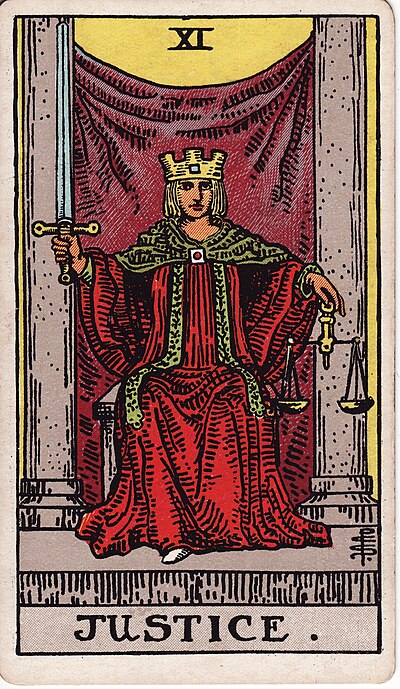
Justice is a crowned figure seated between two pillars, a sword raised in one hand and scales held level in the other. The card is about fairness and truth — the consequences that follow from what was actually done — and about the difference between being judged and taking responsibility.
- Upright
- fairness · truth · accountability
- Reversed
- injustice · dishonesty · avoidance
- In numerology
- Master number 11
What the card shows
On the Justice card a figure in a red robe sits on a stone bench between two gray pillars, a purple cloth hung behind them. The crown is plain; the face is unsmiling but not hard. The right hand holds a sword straight up, point toward the sky, an edge that favors no side; the left holds a pair of scales that are exactly level. One foot has slipped forward from under the robe, as if the figure is about to stand. There is no blindfold — this Justice looks straight at you. A small square clasp closes the robe at the throat, order over the heart. The number is eleven: two ones side by side, a balance that is also a doorway.
Justice · Upright meaning
Upright, Justice names the moment the account is read. Something is being weighed — a decision with real consequences, a truth that has been waiting for its hearing, the honest sum of what you have given and taken — and the card's gift is clarity about it: the sword that cuts a tangle into two clean halves, the scales that show what a situation actually weighs when the stories are set aside. It asks for accountability that begins at home, the willingness to be judged by the same measure you would use on anyone. The shadow lives close to the gift, as it always does. Fairness can harden into scorekeeping; the love of truth can become a habit of prosecution, and a person can be so busy being right that they forget to be kind. The card is not telling you who is at fault. It is asking what you already know to be true about this, and what it would cost to say so.
In love
In love, Justice is the honest conversation — the one where both sides of the scale are put on the table and looked at together — and the relationship that can survive it. It favors clarity over comfort and equal weight over grand gestures. Where a connection is new, the card asks whether what you are showing and what you are hoping for are the same thing. Where it is older, it asks where the balance has quietly tipped: who decides, who apologizes, who waits. The reflection it offers: if you both wrote down what is fair here, how different would the two lists be, and which line would surprise you?
In work and money
At work Justice is the decision made on the evidence, the review that says what happened rather than what was hoped, the moment credit and blame land where they belong. It is a card of consequence rather than intention, and it is honest that consequence is uncomfortable: the sword does not cut only where it is convenient. It rewards the record kept, the number checked, the reason written down before the outcome is known. Its question for the working week: where are you asking to be judged on effort while judging someone else on results?
What the card asks
Weigh it before you cut. Say the true thing in plain words and let it carry its own consequences. Keep the scales level even when your thumb is itching, and take your share of the weight first — accountability that starts elsewhere is only complaint. And notice the foot stepping forward: a judgment is not finished until something is done about it.
Justice · Reversed meaning
Reversed, Justice's scales tip and the sword turns sideways. Something feels unfair, an injustice done or received — a consequence that landed on the wrong person, a truth that was bent to fit a story, a decision made by whoever spoke loudest. Or the card shows the failure closer to home: avoidance of the reckoning, the account left unread because reading it means owning a line in it, dishonesty that began as tact and stayed. Both are the same card unbalanced. The gift is still there, underneath — a real sense of what is fair that has been outvoted, or outrun. The reflection is not «demand what you are owed», but «what have you left out of the weighing?»
In love
Reversed in love, Justice can describe a ledger kept in secret — every favor counted, every slight filed — or a relationship in which one person's version of events has quietly become the only one. It may point to an apology that is owed and has been postponed into a habit, or to unfairness accepted for so long that it feels like the shape of the room. The question it leaves: are you being treated fairly, and are you being honest about how you treat them?
In work and money
In work, Justice reversed is the blame that rolls downhill, the process followed in name only, the outcome decided before the review. It can be the person who avoids every decision that might be wrong, so that nothing is decided and everyone pays. Or it is the honest mistake that goes unmentioned because mentioning it might cost a career. The card asks for one plain sentence about what actually happened, said to the person who most needs to hear it, and for the scales to be set down where everyone can see them.
What the card asks
Put the thumb back in your pocket. If you have been wronged, state the fact without the verdict and see what the fact alone does. If you have been avoiding, read the one line of the account you have been skipping; it is usually shorter than the dread of it. Justice reversed is not a sentence passed on you. It is a reminder that fairness is a thing you do, and that the sword and the scales are both in your own hands.
Updated September 24, 2026