Minor Arcana · Wands
Two of Wands tarot card meaning
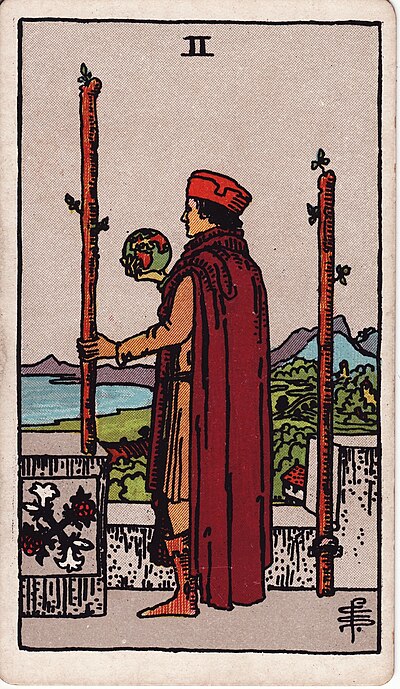
The Two of Wands is a man on a castle roof holding a small globe in one hand and a tall staff in the other, looking out over the sea to land beyond. The card is about planning — the world held in the palm before the first step is taken toward it — and about the difference between a view and a journey.
- Upright
- planning, first step
- Reversed
- fear of change, playing safe
- In numerology
- Number 2
What the card shows
The Two of Wands shows a man in a red robe and a red cap standing on the flat roof of a castle, between battlements, his back half-turned to us. In his right hand he holds a small globe, the whole world made portable; in his left, a tall wooden staff sprouting leaves. A second staff stands beside him, fixed to the stone with an iron ring. On the face of the parapet to the left, a cross is made of two flowers — a white lily and a red rose, set over each other. Below and beyond him the view opens: a bay, a shore, mountains in the distance, the sea flat between. He is looking at the horizon, not at the globe. Nothing has been set in motion; the picture is the moment before. Two is the first number that allows a choice, and the card holds both staves — one in the hand, one left in the wall.
Two of Wands · Upright meaning
Upright, the Two of Wands names the planning stage — the spark of the Ace has become a direction, and the direction has become a view. Something is wanted, and the card's gift is the perspective that comes from standing high enough to see where it lies: the globe in the palm, the route sketched, the first step chosen even if not yet taken. It asks for exactly this — the first step, not the whole journey — and it rewards the person who can hold ambition and patience in the same pair of hands. The card is honest that a plan is a kind of pleasure, and that pleasure can be enough for some people. The shadow sits close to the gift: the roof is a comfortable place to stand, and a view can be looked at for years. The world in the hand is small enough that it never needs to be entered. The card is not telling you where to go. It is asking what you can already see from where you stand, which of the two staves you are actually holding, and what the first step down from the roof would be.
In love
In love the Two of Wands is the relationship at the point of deciding what it is going to be — the conversation about the future had for the first time, the map of two lives laid side by side to see where they overlap. It favors intention over drift, and it is honest that intention can feel like a loss of spontaneity. Where a connection is new, the card asks what you actually want from this, in words, before you ask the other person what they want. Where it is older, it asks whether the two of you still stand on the roof together and look out, or whether one of you has been holding the globe alone. The reflection it offers: what horizon do you see when you picture this relationship, and have you said it aloud?
In work and money
At work the Two of Wands is the strategy session, the business plan, the decision about which market to walk into first. It is a card of foresight applied — the view from the roof turned into a route — and it is honest that plans are cheaper than steps. It rewards the person who can name the first move rather than only the destination, and the team that leaves the roof once the map is drawn. Its question for the working week: what have you planned thoroughly enough that the next thing is not more planning — and what is stopping you from taking the staff out of the wall?
What the card asks
Hold the world in one hand and the staff in the other, and then put one of them down. Choose the direction you can see and take a step in it, however small — a message, a booking, a first line. Leave the second staff in the wall for now; you are not required to bring everything. And notice the flowers set into the wall: the lily and the rose were put there by someone who stood here before you and went.
Two of Wands · Reversed meaning
Reversed, the man on the roof has stopped looking out. The plan is made and remade, the globe turned over and over, and the staff never leaves the wall — the Two of Wands reversed describes fear of change dressed as prudence, playing safe so consistently that it stops being a choice and becomes a residence. It can also describe the opposite failure: a leap taken with no view at all, the roof abandoned before the horizon was even looked at, so that the journey is all movement and no direction. Both are the same card unbalanced — one cannot leave the vantage point, the other never found it. The gift is still there, underneath: the wish to go somewhere has not died, it has only been outvoted. The reflection is not «be brave», but «what exactly would you lose by leaving the roof, and have you checked that the loss is real?»
In love
Reversed in love, the Two of Wands can describe a couple who have talked about the future so long that the talking has replaced it, or a person who keeps every relationship at the planning stage, where nothing can go wrong because nothing has begun. It may point to a safe arrangement kept because the alternative is unknown, or to a decision about the two of you that has been made and never acted on. The question it leaves: have you chosen to stay on the roof, or only avoided finding out what leaving it would mean?
In work and money
In work the reversed Two of Wands is the strategy revised for the fourth year, the pilot that never becomes the product, the career move mapped in detail and postponed until the map is out of date. It can be a company so cautious that the market it planned for has moved on by the time it walks in. The card asks what you have been calling preparation, and what a plan looks like when it is really a way of staying home.
What the card asks
Take the staff out of the wall, or admit you are not going. Either is honest; the years on the roof are not. If fear of change has been steering, name the specific thing you are afraid of losing and test whether it is as large as it feels. If you have been leaping without looking, climb back up for one afternoon and actually look. The Two of Wands reversed is not a verdict on your courage. It is a reminder that a view is a beginning, and that the world in your hand was always meant to be walked into.
Two of Wands · Yes or no
How the tradition leans — something to weigh, never an answer the cards decide for you.
- Upright
- maybe
- Reversed
- leans no
The Two of Wands is a card of planning and choice, so the tradition usually counts it as a maybe upright: the direction is visible from the roof, but the first step has not been taken, and the answer depends on whether it is. Reversed it leans to no, because fear of change and playing safe keep the staff in the wall; the plan is made and remade instead of walked. Rather than settling the question, the card asks what you can already see from where you stand — and whether you are asking because you are unsure of the route, or because you have not yet decided to leave.
Two of Wands · As feelings
In a feelings reading, the Two of Wands suggests anticipation — someone weighing a future, thinking ahead, picturing where a connection might go without yet acting on it. If the question is someone else's heart, it reads as considering: curiosity with a plan forming behind it, perhaps a little caution about leaving familiar ground. Reversed, it points to hesitation turning into comfort — interest kept at the planning stage because nothing can go wrong there, or a fear of change that holds a feeling back. Ask yourself: am I looking at this horizon because I want to go, or because looking is safer?
Two of Wands · As a person
The Two of Wands describes the planner and visionary — someone with ambition and the patience to map it, who likes to see the whole terrain before setting out. They are good at strategy, comfortable with big pictures, and often the one in the group who asks where all this is heading. In balance they hold the globe and the staff at once and then actually take the step. Off balance, reversed, the same person can stay on the roof for years, revising plans that never meet the world, or leap without looking just to escape their own caution. Anyone at the edge of a decision has stood where they stand.
Updated October 7, 2026