Major Arcana
Judgement
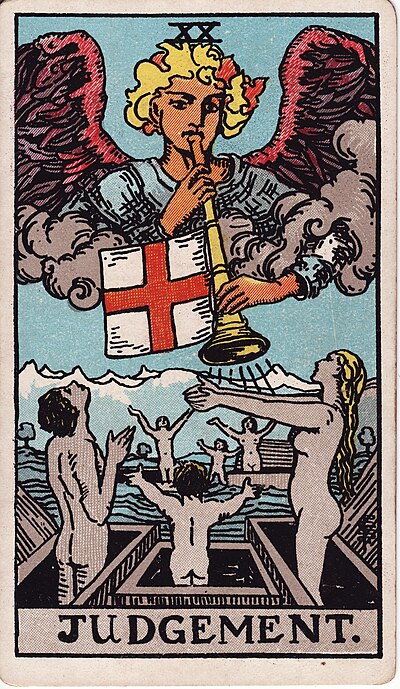
Judgement is an angel in the clouds sounding a trumpet, and below, gray figures rising from their coffins with their arms open to the sound. The card is about awakening — the call that cannot be unheard, the reckoning with what you have been and the chance to answer it — and about the difference between a verdict and a summons.
- Upright
- awakening · reckoning · second chance
- Reversed
- self-doubt · ignoring the call · harsh self-judgment
- In numerology
- Number 2
What the card shows
On the Judgement card an angel leans out of a bank of cloud, wings spread, and blows a long trumpet from which hangs a square white banner with a red cross. Below, the earth is water, and on it float open coffins; from them rise gray-skinned figures, naked, arms lifted toward the sound. In the front a man and a woman turn their faces up, and between them a child stands with its back to us, arms out; behind them more are rising from other coffins. The mountains on the horizon are pale and high, and there is a great deal of sky. Nobody is being struck or sorted; everyone is being called, and everyone is answering. The number is twenty: two and the Fool's zero, and the card that comes one short of the end. This deck spells the name Judgement; American English writes Judgment, and both name the same card.
Judgement · Upright meaning
Upright, Judgement names the moment you hear yourself called. Something summons — a realization, a conscience, a purpose that has been waiting under the water for a long time — and the card's gift is that the summons is an awakening rather than a sentence. It asks for a reckoning: an honest account of who you have been, what you did with what you had, and what is still owed. But look at the picture: everyone rises, and nobody is turned away. The reckoning is the second chance, not the thing that stands between you and it. The card rewards the person who can hear the trumpet without arguing with it, who can say «yes, that was me» about the old life and still stand up out of the box. The shadow sits close to the gift. A reckoning can curdle into a trial in which you are both the accused and the judge, or the call can be so loud and so vague that it becomes a permanent state of being about to change. The card is not telling you what you are guilty of. It is asking what you already know you are being called toward, and how long you have been lying still and pretending not to hear.
In love
In love Judgement is the moment a relationship is seen whole — what it has been, what each of you has done in it, and whether it is something you would choose again from here. It is the card of the honest account between two people, and it is kind about the answer, because the picture is of rising, not sentencing. Where a connection is new, it asks what you are bringing up out of your own old coffins, and whether the other person has been told. Where it is older, it asks what the two of you would say about the years if you were both being entirely truthful for one hour. The reflection it offers: if you were called to account for how you have loved, what would you be proud to say, and what would you want another chance at?
In work and money
At work Judgement is the review that tells the truth, the career reckoning at forty or at twenty-six, the decision about whether the work you do is the work you were called to or the work you drifted into. It is a card of purpose rediscovered, and it is honest that purpose usually arrives as discomfort first. It rewards the person who can look back on a body of work and say clearly what mattered in it and what was noise, and then act on the difference. Its question for the working week: if you heard a trumpet over your desk tomorrow, what would you stand up from — and what would you take with you into whatever comes next?
What the card asks
Stand up when you hear it. Do not spend the call debating whether you deserve it; the figures in the picture do not, and they are rising. Give an honest account — to yourself, in words — of what the old life was, including what was good in it. Then turn your face up. Judgement is not asking you to be found innocent. It is asking you to be found awake.
Judgement · Reversed meaning
Reversed, Judgement's trumpet sounds and the figure stays in the box. Self-doubt takes the place of reckoning: the call is heard and argued with — «not me», «not yet», «not after what I did» — and the lid stays half-open for years. Or the judging has gone inward and turned into harsh self-judgment: a tribunal that never adjourns, the account of the old life kept as a list of charges, nothing in it allowed to count for the defense. The card can also describe the call ignored outright, the purpose known and set aside because answering it would mean changing more than feels possible. All of these are the same card, refused. The gift is still there, underneath — the angel does not pack up the trumpet because one figure lay still. The reflection is not «forgive yourself», said easily, but «who appointed you judge in this, and is the sentence you keep passing one you would pass on anyone else?»
In love
Reversed in love, Judgement can describe a person who cannot forgive themselves for how a past relationship went and so cannot fully enter the next one, or a couple keeping a tally instead of an account. It may point to a call heard clearly — this is over, or this is the one — and left unanswered because answering has a cost. The question it leaves: are you still being sentenced for something, and if so, who is holding court?
In work and money
In work, reversed Judgement is the feedback that turned into a verdict about your whole worth, the career change known about for years and never begun, the person so afraid of being judged that they never put anything up to be seen. It can be a team that has learned to expect the tribunal and so hides every mistake until it is a disaster. The card asks for one honest look at the difference between accounting for your work and prosecuting yourself for it — and at which one you have actually been doing.
What the card asks
Loosen the gavel. If you have been judging yourself, read the charge sheet as if it were about someone you liked, and see what you would strike. If you have been ignoring a call, do not answer all of it today — just admit, in plain words, that you heard it. None of the figures in the picture is too late to rise. Judgement reversed is not a guilty verdict. It is a reminder that the trumpet is still sounding, and that the box was never locked.
Updated September 24, 2026