Major Arcana
The Sun tarot card meaning
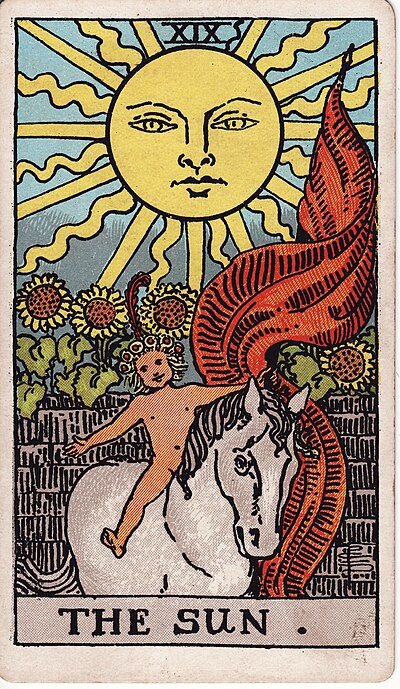
The Sun is a naked child on a white horse under a great sun with a face, holding a red banner high, with sunflowers along a wall behind. The card is about joy — the plain kind, that needs no explanation — and about vitality as its own success. It asks what you are like when nothing is hiding, and whether you have let anyone see it lately.
- Upright
- joy, success, vitality
- Reversed
- dimmed joy, overconfidence, delays
- In numerology
- Number 1
What the card shows
The Sun itself, with a calm face, fills the upper half of the picture, its rays alternating straight and wavy, its light the whole sky. Below it a small naked child sits astride a white horse, arms wide, no saddle and no reins, a red feather standing up from a wreath on its head like the one the Fool wears. In one hand the child holds a long red banner that streams out behind, taller than the horse. Behind them runs a gray stone wall, and over it lean four sunflowers, their faces turned out toward us. The horse is calm; the child is unafraid of falling. There is nothing else: no path, no towers, no water. The number is nineteen: one and nine, the Magician's beginning and the Hermit's lamp, and here the lamp is the whole sky.
The Sun · Upright meaning
Upright, the Sun names a happiness with nothing hidden in it. Something is going well and knows it — a success that does not need to be defended, a vitality that has come back into the body, a joy that is simple enough to be embarrassing. The card's gift is warmth without shadow: clarity, energy, the sense of being fully lit and finding that survivable. It asks for the child's posture — arms open, nothing held back, no reins because none are needed — and it rewards those who let a good thing be good without auditing it. The shadow sits close, though on this card it is thin. Light this strong can be blinding, and a person warmed by it can forget that others are standing in the shade; joy can become a performance of joy, the banner waved for the wall. And the Sun that is only ever pleasant is not the Sun — the card includes the heat. The card is not telling you that everything is fine. It is asking what in your life is already lit, what you have been too busy squinting at problems to enjoy, and who you would let see you with the feather on.
In love
In love the Sun is the relationship that can be seen in daylight — the affection that does not need the room dimmed, the laughter in the kitchen, two people who like each other in front of witnesses. It favors openness over mystery and warmth over strategy. Where a connection is new, the card asks whether you can be this uncomplicated with the person — not simple, uncomplicated — or whether some part of you is holding the reins. Where it is older, it asks when the two of you last did something for no reason but the pleasure of it, and what happened to that habit. The reflection it offers: what does the person beside you look like in full light, and when did you last actually look?
In work and money
At work the Sun is the project that lands, the recognition that arrives in public, the team that has stopped protecting itself and started enjoying the work. It is a card of career success, and it is honest that success has a temperature: it is warm, and warmth either spreads or it does not. It rewards the person who shares the light — the credit given by name, the win celebrated with the people who made it — and the plain confidence that comes from having done a thing rather than from having said you would. Its question for the working week: what is going well that you have not said out loud, and who else was in the picture when it went well?
What the card asks
Let the good thing be seen; joy that hides is half a joy. Ride without reins where you can — the horse is calm, not bolting — and turn your face to the warmth instead of the wall. If you catch yourself listing the reasons this cannot last, notice that the sunflowers are not doing that. Then go and stand in it, briefly, on purpose, with the feather on.
The Sun · Reversed meaning
Reversed, the Sun is still up and the child has climbed down. Joy dims — not into grief, but into a grayness where good news is received with a shrug and the body forgets how to be warm. The card can describe delays: the success that is real and keeps not arriving, the summer that stays behind cloud. Or it shows the opposite excess — overconfidence, the light so trusted that nothing is checked, the banner waved over a plan that never met a wall. Both are the same card turned from the light: one has stopped believing in the warmth, the other has stopped believing in anything else. The gift is still there, underneath — the sun does not go out because someone is standing in the shade. The reflection is not «be positive», but «what stands between you and the light right now, and did you put it there?»
In love
Reversed in love, the Sun can describe a relationship that has stopped being fun without either person noticing when, the affection intact and the play gone. It may point to a warmth that was mostly display — the couple bright in company and gray at home — or to a happiness postponed until some condition is met that keeps moving. The question it leaves: when did the two of you last laugh at nothing, and what has been standing in the sun's place since?
In work and money
In work the reversed Sun is the win that turns out to have been announced too early, the confidence that skipped the test, the launch pushed back for the third time while morale quietly goes indoors. It can also be the team that succeeded and could not feel it, so used to bracing that the good result found nobody home. The card asks whether the delay is the world's or your own — and what it would cost to be pleased about something before it is finished.
What the card asks
Step out from the wall. If the joy has dimmed, do one small thing today that has no purpose except pleasure, and notice what your body does with it. If you have been riding on light alone, check one thing you have been sure of — not to spoil the mood, but so the confidence has ground under it. The Sun reversed is not the end of the good season. It is a reminder that the light is still there, that a child can climb back onto a calm horse, and that a delay is not a refusal.
The Sun · Yes or no
How the tradition leans — something to weigh, never an answer the cards decide for you.
- Upright
- leans yes
- Reversed
- maybe
Ask the Sun a yes-or-no question and the tradition gives one of its clearest yes leans. Upright the card is joy, success and vitality with nothing hidden in it, and an answer that can stand in full light tilts toward yes. Reversed it becomes a maybe, or a yes that is slow: dimmed joy, delays, or an overconfidence that has skipped a check — the warmth is still there, but something stands between you and it. Even at its brightest the Sun is not a promise. It asks what is already going well around your question, and whether you would let yourself enjoy it before it is finished.
The Sun · As feelings
In a feelings reading the Sun suggests warmth that does not need hiding — delight, ease, affection that is glad to be seen in daylight. For another person, the tradition reads openness and plain enjoyment of the connection, a mood of being lit up; it describes a mood, not a fact about anyone's heart. Reversed, the warmth dims or turns into a show: happiness postponed, a grayness where good news lands with a shrug, or a brightness worn in company and missing at home. The question to ask yourself: when did I last feel simply glad around this, and what has dimmed it since?
The Sun · As a person
The tradition sees in the Sun the radiant one — warm, direct, playful, the friend who makes a room brighter just by being glad to be in it. They are generous with praise, quick to celebrate others, unembarrassed by enthusiasm, and they make openness look easy. The card's figure is a child, and anyone of any age who still rides without reins carries it. Turned over, the same brightness can become overconfidence that never checks the plan, a need to be at the center of every picture, or a cheerfulness worn as a costume over tiredness. Their gift is reminding people that joy is allowed to be simple.
Updated October 7, 2026