Minor Arcana · Swords
Ace of Swords
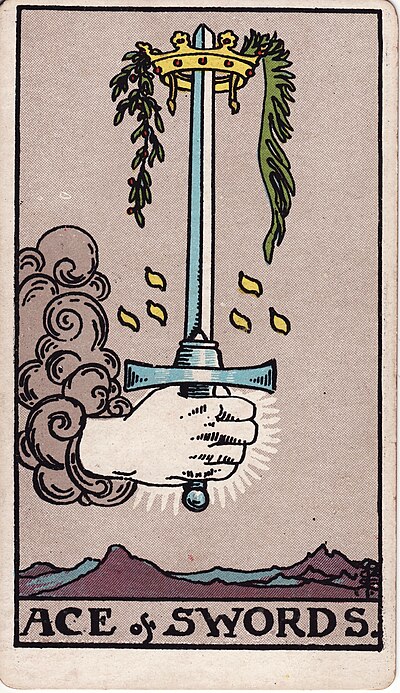
The Ace of Swords is a hand from a cloud holding a sword upright, a crown on its point hung with a palm and an olive branch, over jagged mountains. The card is about clarity — the thought that cuts through, the truth that can be said in one sentence — and about the difference between a breakthrough and a blow. It is where the suit of air begins.
- Upright
- clarity · breakthrough
- Reversed
- confusion · harsh truth
- In numerology
- Number 1
What the card shows
The Ace of Swords is a single blade: a hand comes out of a gray cloud at the left of the picture, gripping a straight double-edged sword by the hilt and holding it upright. On the sword's point rests a golden crown, and from the crown hang two branches — a palm on one side, an olive on the other. Six small flames or drops hang in the air around the blade. Below, the land is a range of gray, jagged mountains without trees or roads, under a pale sky. There is no figure, no landscape a person could live in — only the blade, the crown it has earned, and the hard country it was raised over. Swords are the suit of air in this deck — thought, speech, judgment, what a mind does with what it knows — and the Ace is the first of them: a single clear idea, before it has been argued with.
Ace of Swords · Upright meaning
Upright, the Ace of Swords names the moment a thing becomes clear. A tangle resolves into one true sentence; a decision that was fog is suddenly a line; and the card's gift is exactly this breakthrough — the mind cutting through to what is actually the case, the truth that can finally be said. It is a card of clarity, of honesty, of the new idea that reorganizes everything around it, and it asks for the sword's kind of courage: to see plainly and to say plainly, even when the plain version is less comfortable than the fog was. It rewards the person who can name the real question in a room full of adjacent ones. The shadow sits close to the gift, and in this suit it is always sharp. A sword has two edges, and clarity that is not held carefully cuts the hand that holds it; a truth said for the pleasure of being right is still a wound, and the crown on the point is a crown, not a target. The mountains below are bare for a reason. The card is not telling you that you are right. It is asking what has just become clear to you, whether you can say it in one sentence, and who you are pointing the sentence at.
In love
In love the Ace of Swords is the honest conversation that has been circled for months and is finally had — the thing said plainly, the confusion cut, the two people who at last know what this is. It favors truth over comfort, and it is honest that truth arriving in a relationship is a breakthrough and a risk in the same breath. Where a connection is new, the card asks what you already know clearly about this person and have been declining to say to yourself. Where it is older, it asks which sentence, if either of you said it, would change the room — and whether the room needs changing. The reflection it offers: what is the one true thing about this relationship that you could say in a single line — and have you said it, to them or to yourself?
In work and money
At work the Ace of Swords is the insight that reframes the problem, the meeting in which somebody finally says what the project actually is, the decision made clean after a quarter of hedging. It is a card of mental clarity and of the courage to be direct, and it is honest that directness has a cost in rooms that run on ambiguity. It rewards the person who writes the one-page version, asks the question everyone was avoiding, or cuts the plan down to what it can actually do. Its question for the working week: what at work has become clear to you that the room has not yet said aloud — and what is the cleanest sentence you could say it in?
What the card asks
Raise the sword and look along the blade. Say the clear thing in one sentence, without the cushions and without the extra edge. Check that the crown is on the point — that this truth is worth something to the person hearing it, not only to you for having found it. Then hold still. A sword that has cut once does not need to keep cutting; the point of clarity is to see, not to keep slicing.
Ace of Swords · Reversed meaning
Reversed, the sword is pointed down and the crown has slipped. The Ace of Swords reversed describes confusion — the idea that seemed clear and was only loud, the fog that returns the day after the breakthrough, the mind so full of arguments that no single one can be followed. Its other subject is the harsh truth: the honest thing said in the cruelest available way, the clarity used as a weapon, the sentence that was accurate and was still a wound. It can also show a truth that has been seen and not spoken, the blade kept in its sheath so long it has rusted. All of these are the same card with its edge misused. The gift is still there, underneath — the capacity to see clearly is not spoiled by having seen wrongly once, or cut badly. The reflection is not «think harder», but «is this confusion because the truth is not clear, or because it is clear and you do not want it?»
In love
Reversed in love, the Ace of Swords can describe a relationship in which nothing is said plainly and everything is implied, or one in which a true thing was said so harshly that its truth was lost in the delivery. It may point to a confusion that both people maintain because clarity would cost one of them something, or to a partner who mistakes bluntness for honesty. The question it leaves: is the fog between you real, or is it a courtesy you are both extending to a truth you already know?
In work and money
In work the reversed Ace of Swords is the strategy document nobody can summarize, the feedback delivered as an execution, the analysis that got sharper and sharper and never became a decision. It can be the team that debates every point to a standstill, or the leader whose clarity has become a career-long habit of cutting people off. The card asks for one honest look at whether your confusion at work is a lack of information or a surplus of argument — and at whether the truths you have been telling were told to help or to win.
What the card asks
Lower the sword and pick it up again by the hilt. If you are confused, write the situation in three sentences and cross out two; the one that survives is usually the one you already knew. If you have cut someone with a truth, go back and say the same truth with the crown on it — the same sentence, aimed at their good rather than at your being right. If you have been keeping a clear thing unsaid, say it once, plainly, and then stop. The Ace of Swords reversed is not lost clarity. It is a reminder that a blade is a tool for seeing, and that seeing was never meant to draw blood.
Updated September 23, 2026