Major Arcana
The Magician tarot card meaning
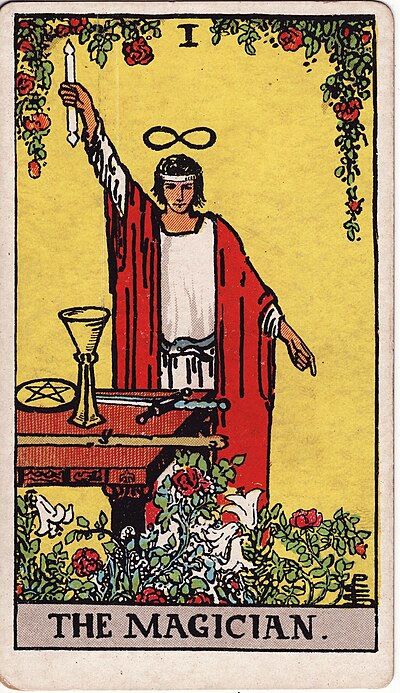
The Magician opens the deck's second act: a figure at a table laid with cup, wand, sword, and pentacle, one hand raised skyward, the other pointing down. Where the Fool arrives with nothing, the Magician arrives with everything already within reach — the tools are on the table before the card even begins. It is a picture of potential turned into method: not the idea of doing something, but the moment attention, will, and material line up enough to actually start.
- Upright
- willpower, skill, manifestation
- Reversed
- manipulation, untapped talent, illusion
- In numerology
- Number 1
What the card shows
The Magician is a young figure in a white robe under a red mantle — purity of purpose dressed in the will to act — standing behind a small table. On it: a cup, a wand, a sword, and a pentacle, the four tools every other suit in the deck will spend its cards using. His right hand holds a wand raised toward the sky; his left points down toward the earth, the old instruction «as above, so below» drawn as a single gesture. Above his head a lemniscate — the sideways figure eight, endless — and at his waist a serpent belt, tail in its mouth. Roses and lilies grow at his feet, flowers grown on purpose rather than found wild: this is craft, not chance.
The Magician · Upright meaning
Upright, the Magician says the ingredients are already on the table. Whatever the question is about — a project, a conversation, a version of a plan — this card marks the point where wanting something starts turning into a method for getting it: willpower with a tool in its hand, manifestation in the plainest sense — attention gathered, a tool chosen, a first move made rather than considered indefinitely. What the card offers is resourcefulness — the confidence that what is needed is closer at hand than it looks, and that starting does not require every condition to be perfect first. The shadow shares the same table. The Magician's hand gestures are persuasive, and persuasion pointed only outward — at how something looks rather than what it does — is a card of showmanship with nothing behind the curtain. The raised wand and the table of tools can describe someone assembling real means, or someone arranging the appearance of means for an audience. Both readings use the same picture. The question the card leaves open: when you look at what is on your table right now, how much of it is a tool you intend to use, and how much is there to be seen holding it?
In love
In love the Magician is the deliberate gesture — the message actually sent instead of drafted and deleted, the plan for the evening rather than the wish for one. It favors a connection where both people are doing something about what they feel, not only feeling it. Where the relationship already exists, the card points at initiative: whose turn is it to make the next move, and has that move actually been made, or only imagined in detail. Its reflection: name one thing between you that has stayed a good intention, and consider what putting a hand to it would look like this week.
In work and money
At work the Magician is competence meeting opportunity — the skill you already have, aimed at the career opening in front of you rather than saved for a better moment. It suits pitches, first drafts, and the use of a tool you have been putting off learning properly. The card does not promise the outcome; it names the resources already available for the attempt. Its question for the working week: of the things you keep saying you could do if you had time, which one could actually be started today with what is already on your desk?
What the card asks
Use what is already within reach before asking for more. One clear action, chosen and taken, does more than a well-organized list of intentions. Keep both hands in the gesture: the reaching upward for the idea and the pointing downward toward the ground it has to land on. A trick that only impresses is not yet a craft — check which one you are practicing.
The Magician · Reversed meaning
Reversed, the Magician's tools stay on the table, unused, or are picked up only for how they look in the hand. It can describe untapped talent — a real skill that has never been pointed at anything, kept as an identity rather than spent on a result — or the opposite, illusion: energy spent entirely on presentation, a wand waved for effect with no working behind it. Manipulation lives here too, when the gesture toward the sky is aimed at persuading someone else rather than clarifying anything for the reader. The gift has not left the picture; the hand has simply stopped choosing where to point. The reflection is not «you have no ability» — it is «where, specifically, have you stopped aiming it?»
In love
Reversed in love, the Magician can mean charm used instead of honesty — the right words arriving too easily, without the follow-through that would make them true. It can also mean a real capacity for connection left unused, a person who would be good at this particular relationship but has not yet tried. The question it raises: is what is missing here a skill, or the willingness to use one you already have?
In work and money
In work the reversed Magician often names talent without traction — the portfolio never sent, the idea explained well in conversation and nowhere else. It can also describe the opposite, a presentation polished past the point where the substance behind it can keep up. Watch for the gap between how something is described and what it would take to actually build it. The card asks for one tool picked up and used today, however roughly, rather than one more version of the plan.
What the card asks
Reversed, the Magician's advice: stop rehearsing and pick one tool up. If the block is confidence, choose the smallest version of the task and finish it badly before trying to finish it well. If the pattern has been persuasion instead of substance, ask what the trick is standing in for, and consider doing that harder thing instead. The Magician reversed is not a verdict on your talent. It is a reminder that the table has not changed, and that what is missing is only a hand willing to commit to one item on it.
The Magician · Yes or no
How the tradition leans — something to weigh, never an answer the cards decide for you.
- Upright
- leans yes
- Reversed
- maybe
Upright, the Magician leans yes in the tradition, and the reason is on the table in front of him: the tools are already there, and the card marks the moment intention turns into a first move. Reversed, it drops to maybe — the talent is real but unused, or the gesture is aimed at how things look rather than what they do, so the outcome depends on what is actually behind it. The card turns the question back on the asker: rather than whether this works, it asks which tool you intend to pick up, and whether you are ready to use it rather than display it.
The Magician · As feelings
Read for feelings, the Magician points to focused interest — attention that is deliberate, a pull that wants to act rather than only daydream. The mood is confidence and intent: someone who feels capable of making something happen and is drawn to the person or plan that lets them use that capacity. Reversed, it can read as charm running ahead of sincerity, words that come easily without the follow-through, or a real wish to connect that keeps getting rehearsed instead of offered. A stance, then, not a fact about anyone. The question it hands back: is what you sense here an intention, or a performance of one?
The Magician · As a person
The Magician as a person is the capable one — the maker, the fixer, the communicator who walks into a room and sees how its pieces could fit together. They are resourceful, quick, persuasive, and at their best they turn ideas into something you can hold: a draft sent, a plan started, a skill put to work. Reversed, the same gifts slide toward showmanship, a talent worn as an identity and never put to use, or persuasion used to steer people instead of clarifying things. The energy is not tied to any gender or age; it belongs to whoever has the tools and decides to use them.
Updated October 7, 2026