Major Arcana
The World tarot card meaning
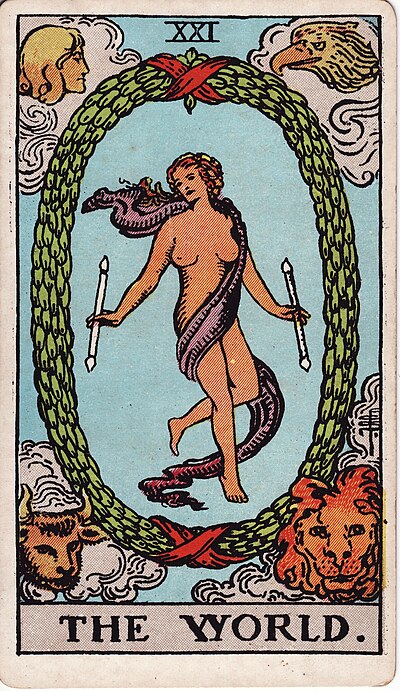
The World is a dancer inside a great wreath, a wand in each hand, with a face at each corner of the sky — a human, an eagle, a lion and a bull. The card is about completion — the cycle finished so thoroughly that it becomes a place to stand — and about the difference between finishing something and being whole. It is the last card of the sequence, and it dances.
- Upright
- completion, wholeness, achievement
- Reversed
- unfinished business, delays, lack of closure
- In numerology
- Number 3
What the card shows
At the center of the World a figure dances in the air inside a large oval wreath of green leaves, one leg lifted, a long violet cloth wound around the body and streaming out behind. In each hand is a short white wand, held loosely, as if the dancing were the point and the wands came along. The wreath is bound top and bottom with red ribbon tied in a figure of eight. In the four corners of the picture, set among small clouds, four heads look on — a human face, an eagle, a lion and a bull — the same four that watched the Wheel of Fortune turn, eleven cards ago, no longer reading. The sky behind is a clear blue. There is no ground shown; the dancer does not need it. The number is twenty-one: the last of the sequence, three times seven, and every card before it is somewhere in this one.
The World · Upright meaning
Upright, the World names a completion that is real. Something has come full circle — a long project, a stage of life, a journey that began with a step off a cliff. The card's gift is the wholeness that follows: not just a finish line crossed but the sense of being all of oneself at once, everything learned present and available, nothing left outside the wreath. It asks for acknowledgment: to stand in the achievement long enough to feel it, rather than reaching for the next thing before the ribbon is tied. It rewards the person who can say «this is done» and mean it. The shadow sits close, even here. Completion can be mistaken for an ending, and a person can stay inside the wreath as if it were a frame, defined by the thing finished; or the dance can be performed for the four watching faces, the achievement becoming a display rather than a state. The card is not telling you that you have arrived. It is asking what has genuinely come full circle in your life, whether you have let yourself know it, and what the next circle might be — because the sequence begins again one card on, and the dancer is already holding the tools.
In love
In love the World is the relationship that has become a whole thing — two lives that have been through enough together that the story has a shape, and the shape is good. It favors the fulfillment of what was promised over the promising, and it is honest that fulfillment is quieter than romance and rarer. Where a connection is new, the card asks what you are bringing to it as a complete person, and what you are still hoping the other person completes for you. Where it is older, it asks whether the two of you have marked what you have made together, or only noted what is still undone. The reflection it offers: what has this love finished in you — and have you told the person who helped?
In work and money
At work the World is the project shipped, the qualification earned, the long apprenticeship that has quietly become mastery. It is a card of achievement, and it is honest that achievement has to be closed to count: the thing launched and then also let go, the ribbon tied, the wands set down for a moment before the next dance. It rewards the person who can look at a body of work and see a whole rather than a to-do list with the top items crossed off. Its question for the working week: what have you actually completed this year that you have not yet allowed to be complete, and what would tying the ribbon on it look like?
What the card asks
Stand inside the wreath. Name what is finished, out loud, and let it be finished — no footnotes, no «but». Thank the four faces if you like; they have been watching the whole time. Then notice that the figure is dancing, not sitting on a throne: wholeness is a movement, and the next step off the next cliff is allowed to be joyful. Keep the wands. You made them.
The World · Reversed meaning
Reversed, the World's wreath is open at the bottom and the dance is not finished. Something stays incomplete — unfinished business: the project at ninety percent, the goodbye never said, the degree with one course missing, the chapter of life that ended in fact and not in feeling. The card describes the ache of the almost: a completion delayed by the world or by the person, a lack of closure, loose ends that have been loose so long they feel like the pattern. It can also show the shortcut — the finish declared before the work was done, the wreath worn as a costume. Both are the same card, left unfinished. The gift is still there, underneath: the wholeness is not canceled by the gap; it is waiting on it. The reflection is not «finish it», barked, but «what is the one thread that would let this close, and why has it been the one you leave for last?»
In love
Reversed in love, the World can describe a relationship that ended without ending — the conversation never had, the box of things never collected, the two people who are technically done and not at all finished. It may point to a connection kept in permanent almost, the commitment always one step away, or to a love that is whole and has simply never been said to be. The question it leaves: what would closure with this person actually consist of, and which of you has been avoiding it?
In work and money
In work the reversed World is the report that has needed one more pass for a year, the launch that keeps slipping, the role left without a handover so that part of you is still there. It can be the career stage that has finished and not been marked, so that the next one never quite begins. It can also be the achievement claimed on the slide and unfinished in the code. The card asks which of the things you call «in progress» are actually stalled, and what a real ending — a date, a delivery, a conversation — would take.
What the card asks
Tie the ribbon on one thing. Pick the smallest incomplete circle in your life and close it today — the message sent, the form filed, the thank-you said — and notice how much room it makes. If a closure depends on someone else, find the part of it that does not, and do that part. The World reversed is not a failure to arrive. It is a reminder that a circle is closed by hand, and that the dance is still waiting for its last step.
The World · Yes or no
How the tradition leans — something to weigh, never an answer the cards decide for you.
- Upright
- leans yes
- Reversed
- maybe
Few cards lean as plainly toward yes as the World. Upright it is completion, wholeness and achievement: the circle closed, the ribbon tied, and a question about whether something can come full circle meets a card in which it already has. Reversed it falls to a maybe, because the wreath is open at the bottom — unfinished business, delays, a closure that has happened in fact and not yet in feeling. The tradition reads this as a lean, not an arrival. The card asks what would need to be finished for your question to answer itself, and which last thread you keep leaving for later.
The World · As feelings
In a reading about feelings the World suggests fulfillment — contentment and completeness, the ease of someone who feels whole in a connection and does not need it to fix them. For another person, it reads as being at home with something that has taken shape over time; a pull toward wholeness, not a fact about anyone. Reversed, the mood is the ache of the almost: feelings left unfinished, a goodbye never said, a closeness kept one step short of commitment. A question for yourself: what in this feels complete to me already, and what am I still waiting on someone else to finish?
The World · As a person
As a person, the World is the integrated one — someone who has traveled, finished things, learned from every stage and carries all of it lightly. They are at ease in many places and with many kinds of people, and they tend to see the whole picture rather than the to-do list. At their best they know when something is done, celebrate it, and move on to the next circle with joy rather than restlessness. The reversal shows the same person keeping a dozen nearly finished projects, struggling with endings, or wearing an accomplishment as a costume over the part that was never completed. It is the portrait of anyone who has come full circle.
Updated October 7, 2026