Minor Arcana · Wands
Six of Wands
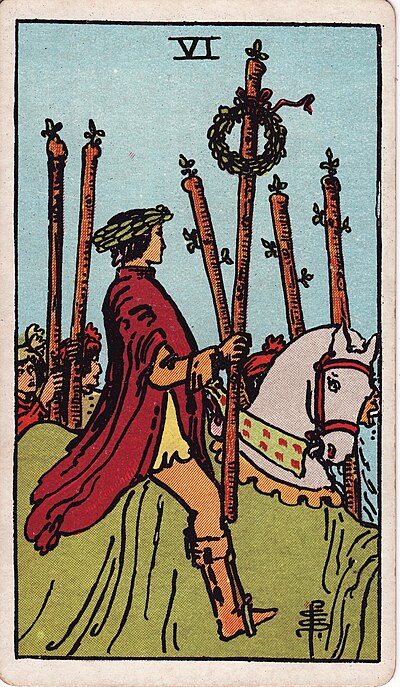
The Six of Wands is a laurel-crowned rider on a white horse, a second wreath on his staff, with people on foot raising staves around him. The card is about victory — the recognition that arrives after the effort and is received in public — and about the difference between being seen and being seen through.
- Upright
- victory · recognition
- Reversed
- fall from grace · self-doubt
- In numerology
- Number 6
What the card shows
In the Six of Wands a man rides a white horse through a small crowd, sitting upright in a red robe with a wreath of laurel on his head. He carries a tall wooden staff, and a second laurel wreath hangs from it, tied with ribbon. Around him men on foot hold their own staves upright, five of them, so that six wands rise together above the group. The horse wears a green cloth and turns its head; the rider looks ahead, not at the crowd. The sky is clear. It is a procession — the return of someone whose venture has come back with good news — but the picture is small and close, a road rather than a stadium. Six is the number that follows the friction of five, and here the staves that were crossing are all pointing the same way.
Six of Wands · Upright meaning
Upright, the Six of Wands names a victory that other people can see. The friction of the Five has resolved into a result; someone has come through, and the card's gift is recognition — the acknowledgment that the work was real, the wreath placed by hands that are not your own. It asks you to receive it: to sit upright on the horse, to accept the crowd's staves raised in your honor without deflecting them into modesty or reaching for the next thing. It rewards confidence that has been earned, and it is honest that earned confidence still needs an audience to complete it; a victory nobody sees is only half a victory to the person who wanted it seen. The shadow sits close to the gift. The wreath can become the goal, the procession the whole point, and a person can begin to need the crowd more than the venture. The rider's back is very straight, and pride has a long history of being one step ahead of a fall. The card is not telling you that you have won. It is asking what you have achieved that deserves to be recognized, whether you can let it be, and what you would be riding toward if there were no one on the road to watch.
In love
In love the Six of Wands is the relationship that can be shown — the partner introduced with pride, the two of you arriving somewhere together and being glad to be seen as a pair. It favors public warmth and mutual admiration, and it is honest that admiration is a form of love that wants an audience. Where a connection is new, the card asks whether you are proud of this person or proud of being with them, and whether the two are the same. Where it is older, it asks when you last told the other person, in front of somebody, what they have done well. The reflection it offers: what victory has this relationship won that you have never celebrated out loud — and who would you tell?
In work and money
At work the Six of Wands is the promotion announced, the pitch that wins, the project that is held up in the all-hands as the way to do it. It is a card of success recognized, and it is honest that recognition is a currency: it can be spent well, on the team that made the win, or badly, on the rider alone. It rewards the person who takes the wreath and then passes the second one down the line, and the manager who names the hands that held the other five staves. Its question for the working week: what have you or your team done that deserves to be seen — and who else needs to be on the road when it is?
What the card asks
Sit up on the horse. Accept the wreath without explaining why you do not deserve it; the crowd has decided, and false modesty is its own kind of arrogance. Then look at the second wreath on your staff — the one you are carrying — and think about whose head it belongs on. Ride forward, not around. A procession that circles the same square is a parade, not a return.
Six of Wands · Reversed meaning
Reversed, the rider is unseated, or was never on the horse. The Six of Wands reversed describes a fall from grace — the success that turns out to have been premature, the recognition withdrawn, the crowd that raised its staves and then lowered them and walked away. It describes self-doubt in the moment of victory: the wreath on the head and the voice inside saying it was luck, or a mistake, or someone else's work. It can also mark a victory that was real and went unnoticed, the return with good news to an empty road. All of these are the same card with the crowd gone. The gift is still there, underneath: whatever was done was done, whether or not anyone applauds it, and a person who can hold that is harder to unseat. The reflection is not «believe in yourself», but «whose recognition were you riding for, and what is left when it is not there?»
In love
Reversed in love, the Six of Wands can describe a relationship that was for show and has lost its audience, or a person who cannot feel loved unless the love is witnessed. It may point to a fall in someone's esteem — the partner once admired now seen plainly — or to a pride between two people that has quietly become competition over who is the more accomplished. The question it leaves: if nobody ever saw the two of you together again, what would be left, and would it be enough?
In work and money
In work the reversed Six of Wands is the promotion that came with more exposure than support, the win credited to the wrong person, the career that fell as fast as it rose because the crowd was its only foundation. It can be the good work done quietly and never noticed, and the discouragement that follows. The card asks for one honest look at where your confidence at work comes from — the work, or the applause — and at what you would keep doing if the applause stopped.
What the card asks
Get down from the horse for a moment. If you have fallen, look at what you actually built before the crowd formed; it is still there. If you are doubting a victory that was real, write down what you did in plain sentences and read them as if they were about someone else. If your work has gone unseen, say so once, to the right person, without a wreath. The Six of Wands reversed is not a disgrace. It is a reminder that recognition is weather, and that the road is walkable without it.
Updated September 23, 2026