Minor Arcana · Cups
Six of Cups
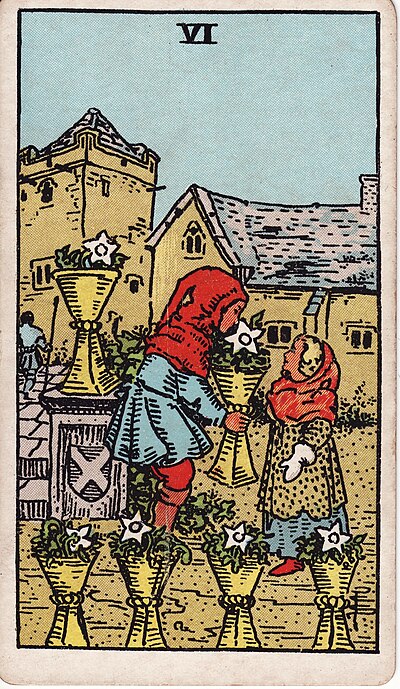
The Six of Cups is a child in a hood handing a cup full of white flowers to a smaller child in a courtyard, with four more cups of flowers around them. The card is about memory — the past returned as sweetness, the innocence that can still be reached — and about the difference between remembering and going back.
- Upright
- nostalgia · innocence
- Reversed
- living in the past · letting go
- In numerology
- Number 6
What the card shows
The Six of Cups is set in the courtyard of an old house, where a child in a red hood and a blue tunic bends to hand a golden cup to a smaller child in a spotted dress and a red headscarf. The cup is filled not with water but with a white five-pointed flower, and so are the others: one on a pedestal beside them, four in a row in the foreground, each holding a single white blossom. Behind them stand the stone walls and stairs of the house, and off to one side a figure walks away with a spear, small in the distance. The sky is pale blue; the light is warm and even. Nothing is happening except the giving. The pedestal beside the children bears a carved shield with a cross. Six is the number of harmony, and the card shows a harmony that belongs to the past tense: an afternoon that has already happened, remembered as it wishes it had been.
Six of Cups · Upright meaning
Upright, the Six of Cups names the return of the past as tenderness. A memory surfaces, a childhood friend writes, a place is revisited, and the card's gift is nostalgia in its warm form: the reminder that there was once a version of you who gave flowers for no reason, and that the innocence in the picture is not gone but stored. It asks for kindness toward what you were, for the simple pleasures that do not need to be justified, for the willingness to receive a gift as a child receives one — without checking what it costs. It rewards those who can visit the past and come back with something. The shadow sits close to the gift. The courtyard is lovely, and a person can move into it: the past made sweeter than it was and preferred to a present that has to be lived in, the old friend loved for who they were at ten, the innocence kept as an excuse not to grow. The card is not telling you that the old days were better. It is asking what from your past is worth carrying forward as a gift, what you have been going back to for comfort, and whether the child in the picture is handing you a flower or asking you to stay.
In love
In love the Six of Cups is the sweetness of familiarity — the partner who knew you before you were finished, the first love remembered, the small kindnesses between two people that are older than any argument they have had. It favors warmth that has history over passion that has none, and it is honest that history can also be a place to hide. Where a connection is new, the card asks whether this person reminds you of someone, and whether that is why you are here. Where it is older, it asks what the two of you were like at the start, and which of those flowers you could give each other again this week. The reflection it offers: what did you love about this person before you knew them well — and is it still there?
In work and money
At work the Six of Cups is the mentor who remembers you as a beginner, the old colleague who calls, the reason you started this work in the first place surfacing in the middle of a hard quarter. It is a card of roots and of simple generosity, and it is honest that a workplace runs on small gifts nobody invoices. It rewards the person who teaches the way they were taught and remembers who taught them, and the team that keeps its founding kindness alive past its founding. Its question for the working week: what made you want to do this work when you began — and where in your current week is any of that still visible?
What the card asks
Take the flower. Let the memory be sweet without auditing it, and give something small for no reason today — the card is made of exactly that gesture. Call the person who knew you before. Then look at the figure walking away with the spear at the edge of the picture: the present is still moving, and you are in it. Visit the courtyard; do not move in.
Six of Cups · Reversed meaning
Reversed, the courtyard has become a residence. The Six of Cups reversed describes living in the past — the old flame kept warm as a reason not to light a new one, the childhood revisited so often that adulthood is where you commute from, the story about how things used to be told until it replaces how things are. In its other face it describes letting go: the moment the past is released as past, the flower given back, the courtyard left with the door open behind you. It can also mark a memory that is not sweet at all, a childhood returned to because it was never finished with. All of these are the same card at the gate. The gift is still there, underneath — the tenderness for what was is not the enemy of what is; it is what the present grows from. The reflection is not «grow up», but «what are you going back for — and would you find it there if you actually went?»
In love
Reversed in love, the Six of Cups can describe the ex who is kept alive in the mind as a standard no living person can meet, or the relationship that runs on memories of itself. It may point to a person who chooses partners for their resemblance to an older comfort, or to the release of an old love that had been held past its time. The question it leaves: are you in love with this person, or with the version of yourself you were when you met them?
In work and money
In work the reversed Six of Cups is the company that talks about the early days more than the current quarter, the veteran who cannot see the team as it is now, the career choice made to please someone who is no longer watching. It can also be the healthy letting go — the old role released without bitterness, the mentor thanked and moved past. The card asks for one honest look at what from your working past you are still carrying — and at whether it is a gift you are using or a weight you have named a gift.
What the card asks
Set the flower down, gently. If you have been living in the past, spend one day this week entirely in the present tense — no comparisons, no «we used to». If an old love or an old self has been held too long, thank it out loud and let it be finished. If the past is a place you were never allowed to finish with, go back once, deliberately, and see it as it was rather than as it was told. The Six of Cups reversed is not a lost innocence. It is a reminder that a memory is something you carry, and that the courtyard has a gate.
Updated September 23, 2026