Minor Arcana · Pentacles
Six of Pentacles
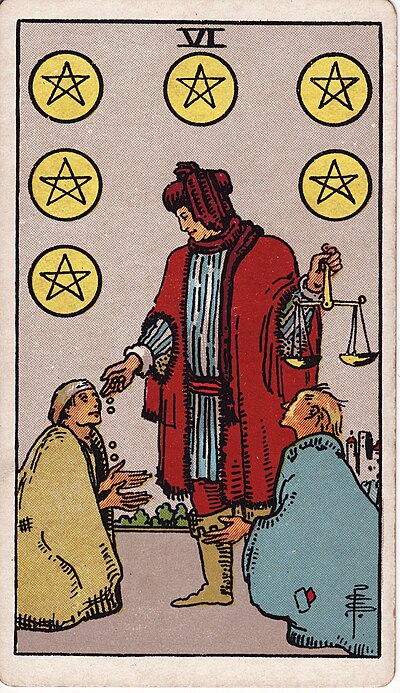
The Six of Pentacles is a richly dressed man with a balanced scale in one hand, dropping coins to one of two kneeling beggars with the other. The card is about generosity — the exchange between someone who has and someone who needs — and about the difference between giving and keeping the scale.
- Upright
- generosity · fair exchange
- Reversed
- strings attached · one-sided giving
- In numerology
- Number 6
What the card shows
The Six of Pentacles centers on a man in a red cloak over a striped tunic, holding a pair of scales level in his left hand and, with his right, letting coins fall into the cupped hands of a kneeling beggar. A second beggar kneels on the other side, hands raised, waiting. Six golden coins are set in the air above and around the group. The giver's face is calm and turned to the one he is paying; the two receivers look up at him. Behind them the outlines of a town show under a pale sky. The scales do not tip. Everything about the picture is measured — who gives, who receives, how much — and the coins go one way. Six restores what five broke, and here harmony is an exchange that works because someone is holding the balance.
Six of Pentacles · Upright meaning
Upright, the Six of Pentacles names generosity that is real and measured. Someone has more and is giving; someone has less and is receiving; and the card's gift is that this can be done fairly — the scales level, the coins actually reaching the hands, the giver looking at the person and not past them. It is a card of charity in the old sense and of fair exchange in the everyday one: the wage that is right, the favor returned, the help given because it is needed and received without shame. It asks you to notice which figure you are in the picture this season, and it rewards both the person who gives without making the receiver kneel lower and the person who can receive without pretending they did not need to. The shadow sits close to the gift, and it is in the scales. A giver who holds the balance decides what is fair; generosity can be a way of keeping the receivers kneeling, and gratitude can be extracted along with the coins. The card is not telling you to give more. It is asking who you are giving to and what you expect back, who you are receiving from and what it is costing you in posture, and whether the scale in the picture is measuring the coins or the people.
In love
In love the Six of Pentacles is the relationship in which one person has more — money, stability, emotional reserve — and gives it, and the other receives; and it is honest that this can be love and can be a hierarchy, sometimes in the same afternoon. It favors generosity that is a gift over generosity that is a position. Where a connection is new, the card asks who is holding the scales, and whether the giving has already begun to shape who kneels. Where it is older, it asks whether what flows between you flows both ways, in whatever currencies you each have. The reflection it offers: what do you give this person that they could not give themselves — and what do they give you that you have never counted as a gift?
In work and money
At work the Six of Pentacles is the fair wage, the bonus shared, the mentor who gives time to a career that cannot yet repay it, the company that pays its suppliers on time. It is a card of exchange that works, and it is honest that exchange is the whole of work and that most of the unfairness in a workplace is a tilted scale nobody looks at. It rewards the manager who gives credit and money where they were earned, and the employee who asks for what is fair rather than waiting to be handed it. Its question for the working week: who holds the scales where you work — and if you looked at the balance honestly, whose hands are receiving less than they are owed?
What the card asks
Give with the scale visible. If you have more, give in a way that leaves the receiver standing — enough, on time, without a speech. If you have less, receive without apologizing for having needed it; the hands in the picture are open, not bowed. Check the balance once: is what you give proportionate to what you have, and what you take proportionate to what you need? Generosity is a fair exchange with time built in. The scale is there so nobody has to guess.
Six of Pentacles · Reversed meaning
Reversed, the scales tip and the coins come with conditions. The Six of Pentacles reversed describes strings attached — the gift that is a debt, the favor that is a lever, the generosity that expects to be remembered at every meal. The other face is one-sided giving: the person who gives and gives and is never handed anything, the receiver who has learned to kneel and stopped standing, the exchange that has become a role for each of them. It can also show the debt that has become the relationship, or the giver who cannot receive because receiving would put them on the wrong side of the picture. All of these are the same card with the scale hidden. The gift is still there, underneath — the capacity to give is real; what has gone wrong is the accounting. The reflection is not «give freely», which is easy to say, but «what do you actually want back for what you give — and have you said so, or only kept the ledger?»
In love
Reversed in love, the Six of Pentacles can describe the partner who gives in order to be owed, or the relationship in which one person has been receiving so long that they have forgotten how to offer. It may point to a generosity that has become control — the gifts that are never quite free — or to a person so used to being the giver that being loved feels like a debt. The question it leaves: what would be left between you if the giving stopped — and would you still be standing, or kneeling?
In work and money
In work the reversed Six of Pentacles is the raise that comes with an unspoken obligation, the mentor who collects loyalty as interest, the team member who carries everyone and is paid the same as the people carried. It can be the supplier never paid on time, or the culture where generosity is a currency and everyone is keeping accounts. The card asks for one honest look at what strings are attached to what you give and receive at work — and at whether the scale is being held by someone who benefits from the tilt.
What the card asks
Say what the gift costs, or make it free. If your giving has strings, name them out loud — «I would like this back» is a fair sentence — or cut them and give the thing whole. If you have been receiving one-sidedly, find one thing to offer, however small, and stand up to hand it over. If you have been giving one-sidedly, stop for a month and see who notices. The Six of Pentacles reversed is not stinginess. It is a reminder that an exchange with a hidden scale is not an exchange, and that fairness has to be visible to be fair.
Updated September 23, 2026