Minor Arcana · Wands
Seven of Wands
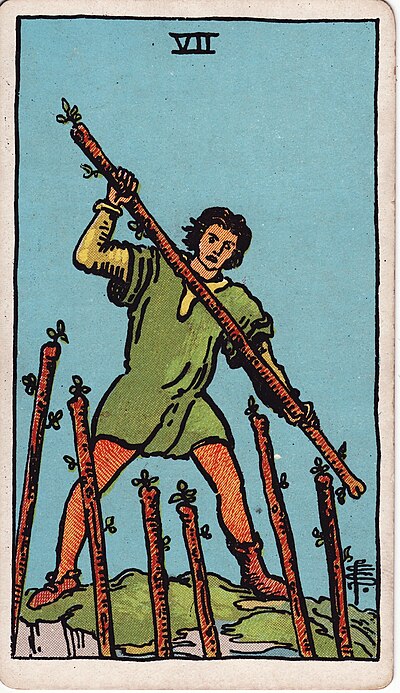
The Seven of Wands is a young man on high ground, staff in both hands, holding off six staves that rise from below — one foot in a boot, one in a shoe. The card is about defense — the position taken and held while it is contested — and about the difference between standing your ground and merely standing.
- Upright
- defense · perseverance
- Reversed
- overwhelm · giving up
- In numerology
- Number 7
What the card shows
On the Seven of Wands a young man stands on a rise of green ground, feet apart, gripping a wooden staff in both hands and angling it downward against six staves that rise from below the edge of the hill. Whoever holds them is out of the picture; only the staves show. He wears a green tunic over an orange garment, and his feet do not match — one wears a boot and the other a shoe, as if he dressed in a hurry or was interrupted. His face is set; he is not afraid, but he is not at ease. The sky is pale blue, the ground bare except for his hill. Nobody is hurt. Seven is the number that asks for effort, and the card shows exactly that: six against one, and the one has the height.
Seven of Wands · Upright meaning
Upright, the Seven of Wands names a position under challenge. Something you have won or built or said is being contested — from below, by several hands at once — and the card's gift is the steadiness to hold it: the high ground kept, the staff angled, the refusal to be talked or pushed off what you know is yours. It is a card of perseverance, and it is honest that perseverance is rarely graceful; the mismatched shoes are the point. It asks you to know what you are defending and why, and it rewards conviction that is prepared to be uncomfortable. The shadow sits close to the gift. A position held too long becomes a siege of one's own making, and the person who defends everything learns to see challengers everywhere. Not every staff raised toward you is an attack; some are questions, and some are offers of help, and a person in a defensive stance cannot tell the difference. The card is not telling you to fight. It is asking what you are holding, whether it is worth the hill, and which of the six staves below you are actually aimed at you.
In love
In love the Seven of Wands is the relationship defended — against family who disapprove, friends who doubt, the couple's own history of giving up. It is the card of standing by someone, and of standing by your own choice of them when it is questioned. It favors loyalty that can explain itself over loyalty that only bristles. Where a connection is new, the card asks what you are defending it against, and whether the challengers are outside the relationship or inside your own head. Where it is older, it asks whether the two of you are standing on the hill together or whether one of you is defending it against the other. The reflection it offers: what in this love is worth holding when it is hard — and have you told the person you are holding it for them?
In work and money
At work the Seven of Wands is the idea defended in a hostile meeting, the position kept while the reorganization tries to take it, the standard maintained when everyone else has agreed to lower it. It is a card of holding ground, and it is honest that holding ground is tiring and that the person doing it is often alone on the hill. It rewards the colleague who can say «no, this matters, and here is why» more than once without raising their voice. Its question for the working week: what are you defending at work that is actually worth it — and what are you defending because giving it up would feel like losing?
What the card asks
Hold the staff and check your footing. Know exactly what you are standing for — say it in one sentence — and defend that, not everything around it. Look at the six staves one at a time; some of them are not enemies. Do not apologize for the shoes: you came as you were, and you are still here. And remember that the hill is not a fortress. You are allowed to come down when the reason for standing has passed.
Seven of Wands · Reversed meaning
Reversed, the staves below are too many and the arms are tired. The Seven of Wands reversed describes overwhelm — the challenges that keep coming until holding the position takes everything and the position itself is forgotten — and it describes giving up: the staff lowered, the hill abandoned, not because the ground was wrong but because there was no one else on it. It can also mark the opposite: a defense so total that the person has become nothing but their stance, unable to yield a single point without feeling defeated. Both are the same card exhausted. The gift is still there, underneath — the conviction that put you on the hill in the first place, which is separate from the strength to stay there today. The reflection is not «don't give up», but «what are you actually fighting for at this point — the thing, or the not-losing?»
In love
Reversed in love, the Seven of Wands can describe a relationship that has become a defense against everyone, including each other, or a person too tired of being questioned to keep choosing what they chose. It may point to the moment of yielding — the argument that stops because someone finally listens — or to a surrender that is really exhaustion. The question it leaves: are you letting go of this because it was wrong to hold, or because holding it alone has worn you out?
In work and money
In work the reversed Seven of Wands is the person who has defended a standard until it broke them, the project abandoned one challenge before it would have held, the manager who stopped pushing back somewhere mid-career and now lets everything through. It can be the meeting in which a good idea is dropped because its owner ran out of arguments, not because it was wrong. The card asks what is exhausting you at work — the number of challenges, or the fact that nobody is on the hill with you.
What the card asks
Put the staff down for a minute, on purpose. If you are overwhelmed, count the challenges actually in front of you rather than the ones you expect; the number is usually smaller. If you have given up something you still believe in, ask whether the problem was the position or the loneliness, and whether one person joining you would change the answer. The Seven of Wands reversed is not a lost battle. It is a reminder that a hill held alone is not a duty, and that asking for a second staff is also a way of holding ground.
Updated September 23, 2026