Major Arcana
The Chariot
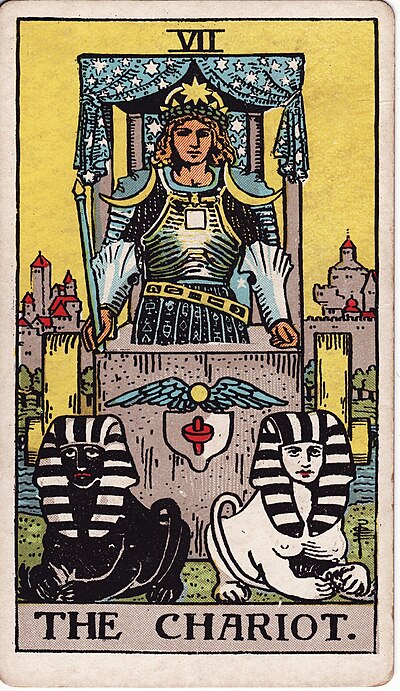
The Chariot is control without reins: an armored figure behind two sphinxes, one black and one white, that face opposite directions. A canopy of stars arches overhead; a walled city sits behind. The card is about moving forward by force of will when the forces involved do not naturally agree with each other — focus strong enough to hold two opposing things on the same course without either one breaking loose.
- Upright
- determination · control · victory
- Reversed
- lack of direction · aggression · obstacles
- In numerology
- Number 7
What the card shows
A figure in armor stands upright inside the open Chariot, crescent moons at the shoulders and a canopy of stars fixed overhead like a small sky carried along with him. Two sphinxes are harnessed at the front, one black, one white, their heads turned in opposite directions as though each intends to walk its own way. There are no reins in the charioteer's hands — nothing physically holds the two sphinxes to the same course except his presence and his will. Behind him, a walled city recedes, already left. A belt marked with signs circles his waist, and the wand or scepter he carries points upward rather than at the sphinxes: not command over them by force, but command by fixed attention.
The Chariot · Upright meaning
Upright, the Chariot is movement achieved by holding two opposing forces on one course without letting either one win outright. The black sphinx and the white are not partners; nothing suggests they would walk the same direction if left alone. What moves the chariot forward is not strength applied to each of them, since there are no reins to apply it with, but a will steady enough that both fall in line simply because the will does not waver. Its gift is exactly that: the capacity to hold conflicting impulses, opinions, or people together long enough to actually get somewhere — a victory won by outlasting the sphinxes' disagreement, not by overpowering it. It suits leaving a place that has become too comfortable, the walled city visibly behind the wheels. The shadow shows when the grip loosens — the sphinxes pull apart, and what looked like control turns out to have been tension barely held, or the charioteer pushes forward by force after all, aggression standing in for the steadiness the card actually asks for. The card is not telling you to hold on harder. It is asking which two things you are holding on the same course right now, and whether it is will that keeps them there, or exhaustion.
In love
In love the Chariot can mean moving a relationship forward through a real difference — different backgrounds, different paces, different instincts — held together by shared determination rather than by the difference disappearing. It favors momentum: a decision to move in together, commit, or work through a hard patch by sheer resolve to keep both of you facing the same direction. Its reflection: are you and the other sphinx actually walking together right now, or is one of you simply not pulling as hard as it could?
In work and money
At work the Chariot suits driving a project through real disagreement — stakeholders who want different things, resources that do not naturally cooperate — by sheer clarity of direction rather than by resolving every underlying conflict first. It favors decisive momentum over waiting for full consensus. Its question for the working week: what is the walled city you need to visibly leave behind in order to actually move this forward?
What the card asks
Hold your direction without gripping so hard that you exhaust yourself keeping it. Let the opposing forces stay opposing — you do not need them to agree, only to move the same way for now. And check occasionally that the city behind you is actually behind you, not something you are still circling.
The Chariot · Reversed meaning
Reversed, the Chariot's two sphinxes pull apart: momentum stalls, or the same effort that once moved things forward turns into force applied without direction — aggression standing in for the focus the upright card runs on. It can mean a loss of control that was, on closer look, always tension rather than actual steadiness, now finally showing. It can also describe the opposite: staying parked at the walled city, unable to leave a comfortable but outgrown situation because moving requires holding forces that currently feel too opposed to manage. Obstacles that the upright card would have steered around get answered with force instead, which tends to multiply them. The canopy of stars is still overhead in this position; what has slipped is the grip. The reflection is not «push harder» — it is «which sphinx have you stopped attending to?»
In love
Reversed in love, the Chariot can mean a relationship pulled in two directions at once — differing goals no longer held together by shared will, each person increasingly facing their own way. It can also describe force used where steadiness was needed: pushing a decision through rather than actually aligning on it. The question: has the direction here been genuinely agreed on, or is one of you simply being outpaced?
In work and money
In work the reversed Chariot often names a project stalled between competing demands that nobody is actively reconciling, or progress that has curdled into aggression — deadlines forced through relationships damaged along the way, obstacles answered with pressure instead of being steered around. It can also mean a career parked too long in a role or company that has stopped moving anywhere. The card asks whether your current effort is actually producing direction, or only friction.
What the card asks
If the Chariot comes up reversed, loosen your grip before you lose it entirely — a will held too tightly for too long breaks the same way a neglected one does. If a conflict has been forced through rather than resolved, go back and actually reconcile the two sides before continuing. And if you have been stationed too long at a city that no longer serves you, name the reason you have not yet left, honestly, before blaming the sphinxes. The Chariot reversed is not a lost battle. It is a reminder that there were never any reins, and that the will which moved the sphinxes once can be steadied again.
Updated September 24, 2026