Minor Arcana · Cups
Ten of Cups tarot card meaning
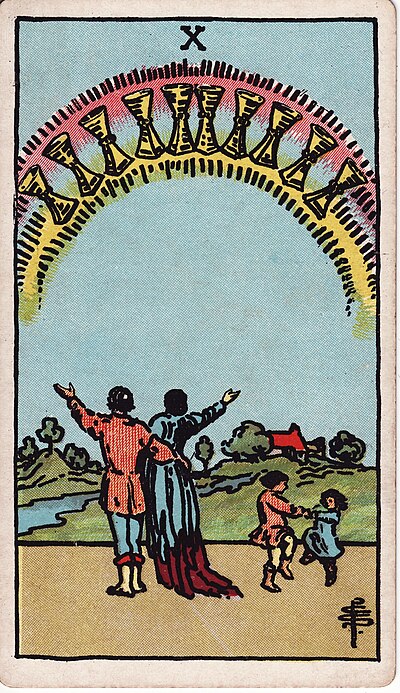
The Ten of Cups is a couple with their arms raised toward a rainbow of ten cups, two children dancing beside them, and a house among trees beyond. The card is about harmony — the happiness that includes everyone in the picture — and about the difference between a family that is whole and a picture of one.
- Upright
- harmony, family happiness
- Reversed
- broken harmony, unmet ideal
- In numerology
- Number 1
What the card shows
In the Ten of Cups a man and a woman stand side by side with their backs half to us, arms raised toward the sky, his arm around her waist. Above them a rainbow arches across the picture, and set into it are ten golden cups. Beside them two children dance, holding hands, oblivious to the sky. The land is green and rolling; a river winds through it, and on a rise among trees stands a house with a red roof. The sky is clear apart from the rainbow. Everyone in the picture is turned toward something — the adults toward the cups, the children toward each other — and nobody is turned toward us. Ten is the last number of the suit, the whole of it at once, and the card shows the whole of it as a household: not one cup filled but ten, and all of them in the air over people who are looking up.
Ten of Cups · Upright meaning
Upright, the Ten of Cups names a happiness that is shared all the way through. Something has come right not for one person but for the people around them — a family at peace, a home that works, a love that has grown outward into a life. The card's gift is harmony in its fullest form: emotional fulfillment that does not depend on anyone in the picture being left out of it. It asks for gratitude and for attention, because a whole this complete is easy to stop noticing, and it rewards those who can stand in their own life and raise their arms at it. The card is honest that this is rare, and that the rainbow is not the weather every day. The shadow sits close to the gift. A picture of harmony can be preferred to the harmony itself — the family that performs its happiness, the couple who look up at the cups so they do not have to look at each other, the ideal held so high that the actual household never measures up to it. The card is not telling you that everything is perfect. It is asking what in your life is already whole and unremarked, who is in the picture with you, and whether you are looking at the rainbow or at them.
In love
In love the Ten of Cups is the relationship that has become a life — the partnership that holds children, or friends, or a home, or simply a shared future that both people can see. It favors lasting warmth over intensity, the everyday harmony over the grand gesture, and it is honest that harmony is something a couple makes rather than finds. Where a connection is new, the card asks what kind of household you are imagining with this person, and whether they are imagining the same one. Where it is older, it asks what the two of you have built that neither of you stops to look at, and who else lives inside it. The reflection it offers: if you raised your arms at this love, what would you be pointing at — and would the person beside you raise theirs too?
In work and money
At work the Ten of Cups is the team that has become something like a family in the good sense — the workplace where people are glad to see each other, the culture that holds, the success that reaches everyone rather than one office. It is a card of shared fulfillment, and it is honest that it cannot be mandated: a rainbow is not a policy. It rewards the leader who measures the whole picture and not only the top of it, and the colleague who makes the room warmer by being in it. Its question for the working week: what at work is genuinely good for everyone in it — and when did you last say so to the people who make it that way?
What the card asks
Raise your arms. Look at the whole of it — the house, the river, the children not paying attention — and let yourself be grateful without adding a footnote. Then lower your arms and look at the person beside you; the rainbow is the sign, they are the thing. Harmony is kept by small acts on ordinary days, and this is one of them.
Ten of Cups · Reversed meaning
Reversed, the rainbow fades and the arms come down. The Ten of Cups reversed describes broken harmony — the household at odds, the family that looks whole in photographs and fractured at dinner, the love that was supposed to become a life and has become an arrangement. It describes the unmet ideal as well: the picture of happiness held up against the actual people, who keep failing to be a rainbow. It can also show a harmony that was real and has been disturbed by something ordinary — a move, an illness, a child grown — and mistaken for a collapse. All of these are the same card with the sky gray. The gift is still there, underneath — the people are still in the picture, even when the cups have come down out of the sky. The reflection is not «fix the family», but «what did you expect this to look like, and who in the picture has been paying for the difference?»
In love
Reversed in love, the Ten of Cups can describe a partnership that has stopped being a home — two people in the same house and different lives, the harmony kept up for the children or the neighbors, the ideal of the family used as a stick. It may point to a couple whose picture of happiness was never the same picture, or to one whose real and imperfect happiness is being spoiled by comparison with a rainbow. The question it leaves: are the two of you unhappy, or are you happy in a way that does not match the picture you were given?
In work and money
In work the reversed Ten of Cups is the team whose culture is a slide deck, the company that talks about family and behaves like a court, the harmony kept because nobody will risk a career by saying anything. It can be the workplace that was genuinely good and has fractured under a change nobody named. The card asks for one honest look at whether the harmony at your workplace is lived or performed — and at who in the picture has stopped looking up.
What the card asks
Lower your arms and look at the people. If the harmony has broken, find the one conversation that has not been had and have it, without the rainbow as a standard. If you have been measuring your life against an ideal, put the ideal down for a month and see what is actually in the house. If a real happiness has been shaken by something ordinary, name the ordinary thing; it is smaller than it feels. The Ten of Cups reversed is not the end of the family. It is a reminder that the rainbow is weather, and the house is where the people are.
Ten of Cups · Yes or no
How the tradition leans — something to weigh, never an answer the cards decide for you.
- Upright
- leans yes
- Reversed
- maybe
Upright, the Ten of Cups is one of the clearest yes cards the tradition knows: harmony that includes everyone in the picture, a home that works, a love grown outward into a life. Reversed it lowers to maybe, because broken harmony and an unmet ideal suggest the outcome depends on whether the real people involved are being measured against a picture of how things should look. The card widens the frame to everyone in it: would this be good for the people around you as well as for you, and are you hoping for a life or for the photograph of one?
Ten of Cups · As feelings
Emotionally, the Ten of Cups is deep, settled happiness — belonging, the warmth of a shared future, affection that has room for family, friends and an ordinary Sunday. It suggests a mood of gratitude and wholeness rather than excitement. Reversed, it leans toward a gap between the picture and the people: tension under a calm surface, disappointment that a family or partnership does not match an ideal, or a harmony disturbed by an ordinary change and felt as a collapse. It sketches the climate of a home, never a fact about someone's heart. Something to ask yourself: whose happiness is part of your picture of happiness?
Ten of Cups · As a person
The Ten of Cups, in a person, is the homemaker in the widest sense — someone who builds a life where the people around them can be well. The figures are a couple and their children, yet anyone who creates belonging, by blood or by choice, fits the picture. When things go well they are warm, devoted and peaceful, the one who keeps a household or a team kind to itself and notices who is missing from the circle. Off balance, reversed, they hold everyone to a picture: smoothing over conflict to keep the image whole, insisting on harmony instead of making room for it, or feeling like a failure because real people refuse to be a rainbow.
Updated October 7, 2026