Major Arcana
The Devil
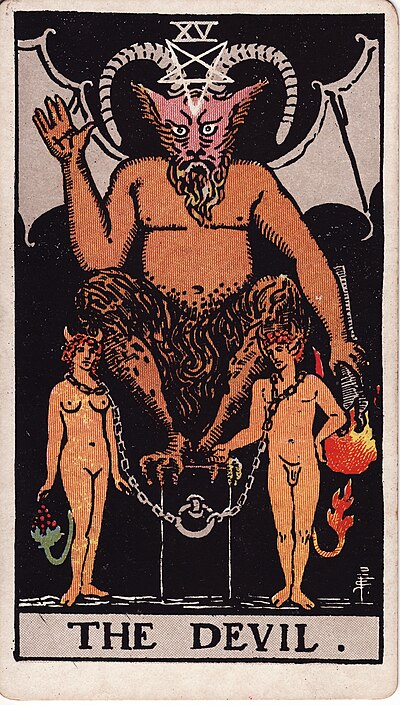
The Devil is a horned figure on a black pedestal with two chained figures at his feet, and the chains are loose enough to lift off. The card is about attachment — the things we keep choosing because they are familiar, and then call fate — and about the difference between a bond and a chain. It is not a card about evil, and nobody in it is being punished.
- Upright
- attachment · temptation · restriction
- Reversed
- release · reclaiming power · awareness
- In numerology
- Number 6
What the card shows
The Devil, a horned figure with a bat's wings, squats on a black half-cube, an inverted five-pointed star on its brow. One hand is raised, palm open; the other holds a torch pointed down, so the fire burns toward the ground. In front of the pedestal stand a naked man and a naked woman, small horns beginning on their heads and tails behind them — his ends in a flame, hers in a bunch of grapes. Chains run from their necks to a ring on the block, and the loops are wide enough to slip over a head. Neither of them looks at the chain. The background is black; nothing grows here. The number is fifteen, and the picture is the mirror of the sixth card, the Lovers: the same pair, a figure above them again, and everything that was open there closed here.
The Devil · Upright meaning
Upright, the Devil names an attachment that has started to run you. Something holds — a habit, a person, a comfort, a story about who you are — and the card's gift is the one thing the two chained figures have not done: it looks at the chain. Not with horror, with attention. What is the bond made of, what does it give, what would the hand feel like lifting it? The card is honest that temptation is real and that most of what tempts us is not wicked but warm: the known misery, the pleasure that asks nothing, the restriction that saves us from having to choose. That honesty is the gift, and the horned figure is almost an ally in it — everything in the picture is shown in full view, nothing hidden. The shadow is where the looking stops. When the chain becomes an explanation («I can't, because…»), when the pedestal is mistaken for the ground, the Devil becomes a way of consenting without admitting it. The card is not telling you that something has you. It is asking what you keep, what it costs to keep it, and whether you have noticed that the loop is wide.
In love
In love the Devil is the bond that runs deeper than the daylight version of the relationship — the pull that does not ask permission, the intimacy that is also a habit, the two people who know exactly which words wound and use them anyway because it is the way they touch. It is a card of attachment more than of affection, and it can describe desire at its most honest and most bodily, which is not a fault. Where a relationship is new, it asks what the attraction is attached to — the person, or the part of yourself they let you be. Where it is older, it asks which patterns between you have become the relationship, so that neither of you would recognize it without them. The reflection it offers: if the chain came off tonight, what would you reach for by morning?
In work and money
At work the Devil is the golden handcuff, the role kept for the salary and the title, the client nobody can afford to lose and everybody has stopped liking. It is also, more quietly, the ambition that has become a compulsion — the work that no longer answers to the reasons it was started for. The card does not condemn any of this; a person can choose a cage for a season and know why. What it rewards is the choosing said out loud, to yourself at least. Its question for the working week: what at work would you keep doing if it stopped paying you in whatever it currently pays you in — and what would you drop in a day?
What the card asks
Look at the chain. Name what it is made of — fear, comfort, pleasure, a promise — without deciding yet whether to lift it. Notice that the torch points down: whatever burns here burns toward the ground, and light is still light. Then try the loop once, just to learn how wide it is. Nothing in the card asks you to leave anything. It asks you to stop calling a choice a fate.
The Devil · Reversed meaning
Reversed, the Devil's block tips and the chains slide. Something that held is loosening — a habit broken or breaking, a dependency seen for what it is, reclaiming power that was handed over to someone or something else. The card is a release, and it is honest about what release feels like: not triumph first, but a cold draft where the warm thing was. It can also show the moment just before — awareness arriving, the first clear look at how the pedestal was built and by whom. Or it shows the loosening that is only a change of chains: one attachment traded for another and called freedom. Both readings are the same card, in motion. The gift underneath is the recovered hand — the one that was raised in a gesture of display and can now be used for something. The reflection is not «you are free», said with a flourish, but «what do you want to do with your hands now?»
In love
Reversed in love, the Devil can describe the end of a pattern between two people — the silence after a fight not fought, the first evening that does not follow the script. It may point to a person stepping out of a bond that had become a bargain, or to two people looking at the same chain together and deciding what it is for. It can also mark a detachment that is really a withdrawal, a coolness put on to avoid feeling the pull. The question it leaves: are you leaving a hold, or a person — and do you know the difference this time?
In work and money
In work the reversed Devil is the resignation letter drafted, the account finally let go, the career ambition set down long enough to ask whether it was ever yours. It can be the team that names the dysfunction everyone worked around for years, or the person who realizes the handcuffs were never locked. It can also be a leaving done in anger that repeats the same bond in a new building. The card asks what you have stopped needing, and what you have merely stopped admitting you need.
What the card asks
Lift the loop slowly. If you have already stepped out of something, let the cold air be part of the release rather than a reason to step back in. If you are only beginning to see the chain, do not rush to break it — awareness is the whole of the first step, and it is enough for today. The Devil reversed is not a rescue. It is a reminder that the hand on the chain was always yours, and that a hand can do other things.
Updated September 24, 2026