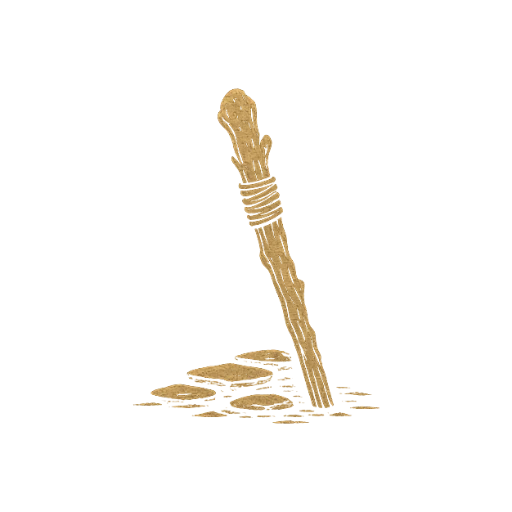
Lunar day 27: the staff
Lunar day 27 is the day of wandering: new knowledge comes from the road, outer or inner, and the gift is a step beyond the usual circle.
- The Moon on this day
- waning crescent, about 10% of the disc lit
The character of lunar day 27
The staff is the traveler's companion and the pilgrim's support, and the twenty-seventh lunar day is read as a day of journeys and of the knowledge that comes from leaving home. The Moon is a thin waning crescent near dawn, the cycle almost complete. The tradition treats the day as favorable for travel, study, intuition and inner exploration — a time when insights arrive sideways, from unfamiliar places and people. It is a day to step outside the usual circle and see what can be seen only from there.
What the day favors
The day favors short trips, a walk somewhere new, meeting people outside one's usual circle, and learning from an unexpected source. It suits reflection, dream journals, music and time near water. A step beyond the usual circle is the gift of the staff.
What can wait
What can wait is flight dressed up as seeking. Running from a problem by starting something new, chasing novelty for its own sake, and abandoning commitments in the name of freedom are the shadow of the twenty-seventh day. The staff supports a journey; it does not replace the destination.
With other people
With other people, the twenty-seventh day favors meeting someone outside your usual circle — a stranger with a story, a friend from another field, a conversation in another language. Fresh company brings fresh perspective. It is also a good day to give someone close the freedom they need.
The question of the day
The day asks where you could step one pace beyond your usual circle — and what you might learn there.
When lunar day 27 falls
The dates in this table count lunar days (also called moon days) from the exact new moon, the same moment everywhere: day one is the first twenty-four hours after it — a table read anywhere cannot follow one horizon. The line at the top of the page counts the traditional way, from moonrise where you are, which can be up to a day apart. How the lunar day is counted
Times are in UTC.
| Begins | Ends |
|---|---|
Updated October 7, 2026
The lunar days
 Lunar day 1: the lamp
 Lunar day 2: the horn of plenty
 Lunar day 3: the leopard
 Lunar day 4: the tree
 Lunar day 5: the unicorn
 Lunar day 6: the cloud
 Lunar day 7: the wind rose
 Lunar day 8: the phoenix
 Lunar day 9: the bat
 Lunar day 10: the spring
 Lunar day 11: the crown
 Lunar day 12: the cup
 Lunar day 13: the wheel
 Lunar day 14: the trumpet
 Lunar day 15: the serpent
 Lunar day 16: the dove
 Lunar day 17: the grape cluster
 Lunar day 18: the mirror
 Lunar day 19: the spider
 Lunar day 20: the eagle
 Lunar day 21: the horse
 Lunar day 22: the elephant
 Lunar day 23: the crocodile
 Lunar day 24: the bear
 Lunar day 25: the tortoise
 Lunar day 26: the toad
 Lunar day 27: the staff
 Lunar day 28: the lotus
 Lunar day 29: the octopus
 Lunar day 30: the swan