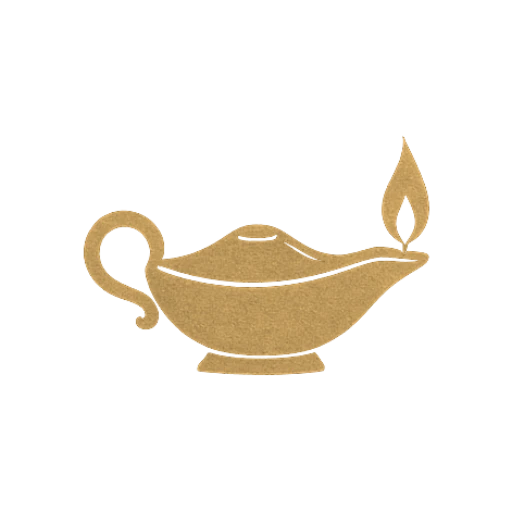
Lunar day 1: the lamp
Lunar day 1 is the day of intention: the new crescent is not yet in the sky, and whatever the coming month is for begins as a plan that ripens in the dark.
- The Moon on this day
- new moon, about 1% of the disc lit
The character of lunar day 1
The first lunar day runs from the exact new moon until the Moon first rises after it, so in the traditional count it can last minutes or most of a day; counted from the new moon itself, it is the first twenty-four hours. Its emblem is a lamp lit in a dark room: there is not yet anything to see, only a small light to see by. The old calendars treat it as the seed day of the month, when the direction is chosen rather than the road walked. Nothing on this day is meant to look finished. Its strength is the quiet before anything has been said, when an intention can still be shaped without having to defend it to anyone.
What the day favors
The day favors naming what the month is for: writing an intention down in a sentence or two, sketching a plan, choosing one thing to tend rather than ten. It suits slow mornings, tidying the space where the work is done, and conversations that are about wishes rather than tasks. A quiet start without haste is the gift of the day — the lamp is lit, and that is enough for now.
What can wait
What can wait is the demand for visible steps. Judging a plan before it has had a day to breathe, announcing it to everyone, and pushing for results where nothing is ready to be seen are the shadow of the first day. Large launches and loud declarations sit more comfortably later in the waxing Moon, once the crescent is up.
With other people
With other people, the first day is better for listening than for persuading. A plan shared too early invites opinions it cannot yet answer, so the tradition keeps intentions close for now — or shares them with one person who can hold them gently. It is a good evening for a quiet talk about what each of you hopes the coming weeks will bring.
The question of the day
The day asks what you want this month to be for — and whether you can say it in one sentence before anyone else hears it.
When lunar day 1 falls
The dates in this table count lunar days (also called moon days) from the exact new moon, the same moment everywhere: day one is the first twenty-four hours after it — a table read anywhere cannot follow one horizon. The line at the top of the page counts the traditional way, from moonrise where you are, which can be up to a day apart. How the lunar day is counted
Times are in UTC.
| Begins | Ends |
|---|---|
Updated October 7, 2026
The lunar days
 Lunar day 1: the lamp
 Lunar day 2: the horn of plenty
 Lunar day 3: the leopard
 Lunar day 4: the tree
 Lunar day 5: the unicorn
 Lunar day 6: the cloud
 Lunar day 7: the wind rose
 Lunar day 8: the phoenix
 Lunar day 9: the bat
 Lunar day 10: the spring
 Lunar day 11: the crown
 Lunar day 12: the cup
 Lunar day 13: the wheel
 Lunar day 14: the trumpet
 Lunar day 15: the serpent
 Lunar day 16: the dove
 Lunar day 17: the grape cluster
 Lunar day 18: the mirror
 Lunar day 19: the spider
 Lunar day 20: the eagle
 Lunar day 21: the horse
 Lunar day 22: the elephant
 Lunar day 23: the crocodile
 Lunar day 24: the bear
 Lunar day 25: the tortoise
 Lunar day 26: the toad
 Lunar day 27: the staff
 Lunar day 28: the lotus
 Lunar day 29: the octopus
 Lunar day 30: the swan