Minor Arcana · Swords
King of Swords
The King of Swords is the only Sword court card to look straight at you: a still figure on a butterfly throne, his sword held upright. The card is about the authority of a clear mind — reason in charge, decisions made on principle — and about the difference between a judge and a tyrant.
- Upright
- intellect · authority of mind
- Reversed
- abuse of power · cold logic
What the card shows
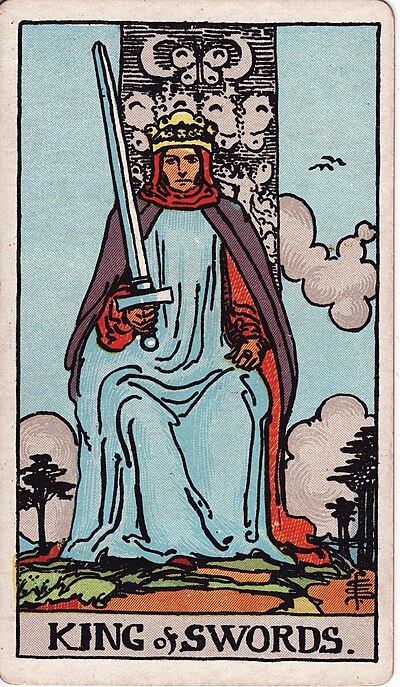
The King of Swords sits facing us on a tall stone throne, holding a sword upright in his right hand, the blade tilted very slightly, his left hand resting on his knee. He wears a blue robe, a violet cloak and a gold crown. The throne is carved with butterflies and crescent moons. Behind him the sky is clear and pale, with a few low clouds; two birds fly in the distance, and the trees on the horizon stand still — no wind here, unlike the Knight's charge. His expression is severe and composed, and he looks straight at us, the only Sword court card to do so. The King is thought that has become authority: the element of air as a person who decides, and whose decisions are meant to hold.
King of Swords · Upright meaning
Upright, the King of Swords names a mind in full authority. Reason is in charge — the facts examined, the principles applied, the decision made and stated in a voice that expects to be understood — and the card's gift is exactly that: clarity that has become leadership, intellect with the power to act, the judge who is fair because he has thought about what fairness requires. It is a card of truth, structure and ethical authority, and it asks for the King's posture: facing forward, sword up but not swinging, one hand at rest. It rewards the person who can decide on principle rather than on mood, and who can explain a decision so that even those it goes against understand why. The card is honest that authority like this is earned by being consistent. The shadow sits close to the gift, and it sits on the same throne. A mind that rules can forget that it rules people; principle applied without mercy becomes tyranny with a good argument, and a King who has stopped listening has stopped being wise however sharp he remains. The card is not telling you that your verdict is sound. It is asking what you have the authority to decide, whether you have decided it on principle or on power, and whether the people it affects could tell the difference.
In love
In love the King of Swords is the partner who is fair — who argues honestly, keeps his word, thinks before he speaks and means it when he does. It favors respect over passion and clarity over charm, and it is honest that so much composure can be hard to reach when what is needed is not a reason but a hand. Where a connection is new, the card asks whether you are being judged fairly or only being judged, and whether you judge the same way. Where it is older, it asks who sets the standard between you, and whether the standard has room in it for the other person's unreasonable days. The reflection it offers: what do you respect in this person — and have you ever told them that, in those words?
In work and money
At work the King of Swords is the leader whose decisions surprise nobody, because they follow from stated principles, the executive who reads the whole brief, the manager whose «no» is explained and whose «yes» is kept. It is a card of intellectual authority applied with integrity, and it is honest that real authority is rarer than the title that claims it. It rewards the person who decides on evidence and says so, and the leader who can be disagreed with in public without punishing the disagreement. Its question for the working week: where at work are you the one whose judgment is trusted — and what principle would you say you were applying if someone asked?
What the card asks
Sit facing forward and decide. Apply the principle you would apply to anyone, including yourself, and say aloud what it is. Keep the sword up and still — authority that has to swing its blade is not authority. Rest the other hand; you do not have to hold everything. And look at the people the decision lands on. A judge who cannot see the room is only a man with a sword and a chair.
King of Swords · Reversed meaning
Reversed, the King's sword tilts and his hand closes on the arm of the throne. The King of Swords reversed describes abuse of power — the authority used for its own sake, the principle bent to serve the person applying it, the judgment delivered to humiliate rather than to decide. Beside it sits cold logic: reason applied where reason was not the point, the argument that wins and the person who loses, the decision that is correct on paper and wrong in every room it enters. It can also show the opposite failure: a King with no authority left, the mind that cannot decide because every decision might be criticized, the throne empty behind a man who is still sitting in it. All of these are the same card with the balance gone. The gift is still there, underneath — the intellect is intact, and only the fairness that made it worth obeying has gone. The reflection is not «be kinder», but «who is this decision actually for — and would you make it the same way if they were sitting where you are?»
In love
Reversed in love, the King of Swords can describe a partner who wins every argument and loses the relationship a sentence at a time, the reason that leaves no room for feeling, or the control that calls itself standards. It may point to a person who has been judged so long that they have stopped presenting a case. The question it leaves: are you being fair to this person, or being right at them — and which of those did you want when you began?
In work and money
In work the reversed King of Swords is the executive who uses policy as a weapon, the manager whose logic is airtight and whose team is leaving, the decision that was defensible and indefensible at once. It can be the leader who has stopped deciding at all for fear that one wrong call could end a career. The card asks for one honest look at whether your authority at work is serving the work or serving itself — and at who has stopped speaking in the rooms you run.
What the card asks
Lower the sword a hand's width and listen. If you have been using power, ask yourself what the decision would look like if you had none, and see how much of it survives. If your logic has gone cold, put one feeling back into the equation on purpose — yours or theirs — and see whether the answer changes. If you have stopped deciding, decide one small thing on principle today and let it be criticized. The King of Swords reversed is not a fallen judge. It is a reminder that authority is borrowed from the people it governs, and that a mind is only as wise as it is fair.
Updated September 23, 2026